A fabric bag manufacturer is a factory that cuts, sews, finishes and packs bags under its own roof. That sounds obvious. It isn't. A large share of the companies selling themselves as bag factories are trading offices that subcontract every stitch, and the difference shows up the first time something goes wrong.
This guide is for sourcing managers and brand owners building a shortlist of custom bag suppliers. It covers what a factory actually does in-house, how to spot a middleman, which documents are worth asking for, how sampling really runs, and how to turn a shortlist into a first order without gambling the whole budget.
What a fabric bag manufacturer actually does in-house
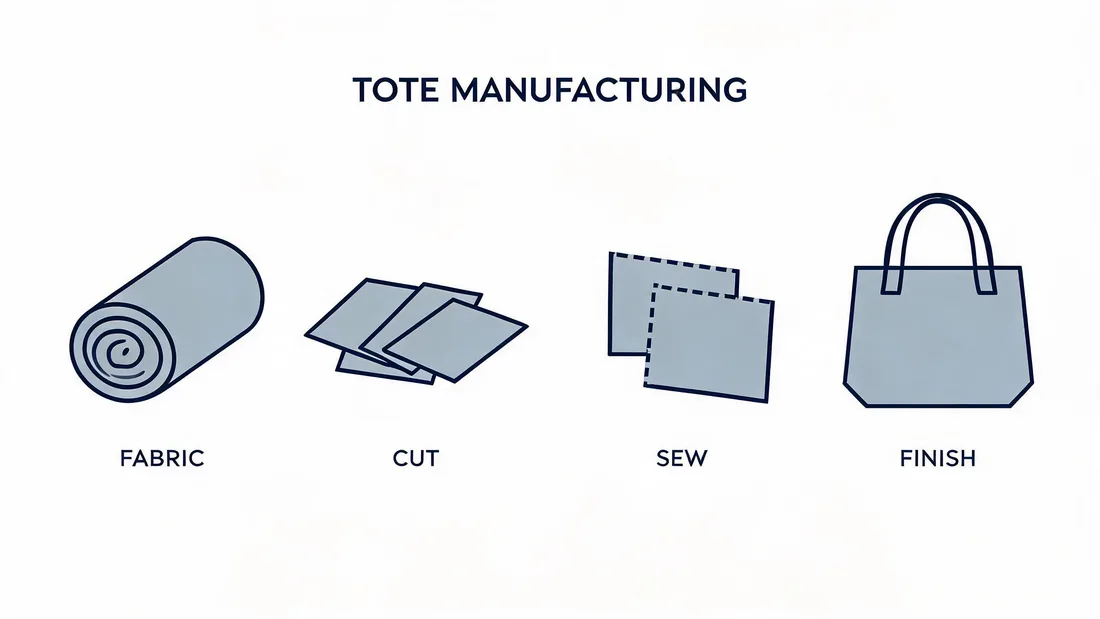
A bag is not made in one step. It moves through separate stages, and each stage is a place where a factory either owns the equipment and the people or hands the work to someone else.
Cutting
Cutting is the first real test. A factory with its own cutting room spreads fabric, nests the pattern pieces, and cuts to a marker plan. That room controls material yield, and yield is where a lot of your cost sits. When a supplier outsources cutting, nobody on their side owns the number.
Sewing and sub-assembly
Sub-assembly means the small parts built before final assembly: pockets, straps, handles, zipper panels, insulated liner sets. A cut-and-sew factory prepares these on dedicated stations, then assembles the bag in a defined sequence. Sewing-only shops skip the cutting and often the sub-assembly too. They buy cut panels or finished components and stitch them together.
Finishing and packing
Trimming, cleaning, shaping and in-line functional checks happen after assembly. Then final inspection, packing and carton verification. These are unglamorous stages, and they are exactly where a trading company has no visibility, because the work is happening somewhere it doesn't control.
Why does an in-house cutting room and sewing floor change how problems get fixed? Because the fix is a phone call to the next room, not a negotiation with a third party who has other clients waiting. If a seam allowance drifts on a strap, an in-house factory can stop the line, re-cut, and re-sew. A trader can only relay your complaint and hope.
Factory or trading company: how to tell the difference
Most buyers get fooled once. The pitch is identical, the website is polished, and the quote comes back fast. Here is how to separate the two before you commit.
Ask who owns the sewing machines. Not who operates them. Who owns them. A factory answers without hesitation. A trader has to check.
Ask for the address of the production floor. If the office and the production share one address, be suspicious. Some legitimate factories do run an office inside the plant, so this alone isn't proof, but combined with other signals it matters.
Ask whether unannounced visits are welcome. A real factory will grumble and say yes. A trader will invent a reason: the floor is being reorganized, the manager is traveling, the dates don't work.
Then ask for a live video walkthrough. Not a recorded marketing clip. A live call where you name a station and they walk to it. What should you see?
- A cutting table with fabric spread and a marker plan visible
- Sewing lines with work-in-progress at multiple stages, not a single finished sample on a table
- A QC station with a measurement method, a defect log and a light box for color checking
- A packing area with cartons, poly bags and a scale
If the walkthrough shows a showroom and a meeting room, you're talking to a sales office. That's not automatically fatal, but price it accordingly. You are paying for coordination, not manufacturing, and you should know which one you're buying.
For a deeper checklist on this specific question, see how to vet a Chinese bag manufacturer.
Documents to request before you pay a deposit
Documents don't prove quality. They prove existence, scope and legal standing, which is the floor you need before money moves.
Start with the business licence. It confirms the legal entity name, the registration jurisdiction and the business scope. Match that legal name against the name on the proforma invoice. If they differ, ask why in writing.
Next, the export licence or the registration that allows the entity to export directly. Some factories export through a trading arm, which is fine, but you should know which entity is shipping and which entity is invoicing.
Then the certificates. The ones worth asking for in this industry are amfori BSCI, ISO 9001, SGS, TUV and GRS. Each covers something different.
| Document | What it actually covers | What it does not prove |
|---|---|---|
| Business licence | Legal entity, jurisdiction, registered business scope | Manufacturing capability or product quality |
| amfori BSCI audit | Social compliance: labour conditions, working hours, safety | Product performance or material quality |
| ISO 9001 | Quality management system at the site named on the certificate | That a specific bag meets a specific specification |
| SGS or TUV report | Results of the specific test named on that report, for the sample submitted | Ongoing production consistency |
| GRS | Chain of custody for recycled content claims | That every product line uses recycled material |
Read the scope wording. A certificate with a scope that excludes bags proves nothing about bags. A quality system certificate for a site that isn't the site making your order proves nothing about your order. This is the single most common gap buyers miss: they see a logo, they stop reading, and the scope line was the whole story.
Be careful with regulatory claims too. CPSIA, REACH and GPSR are regulations, not certificates a factory holds. If a supplier says its bags are certified to one of them, ask which test, which lab, which sample. Details of these rules change, so check current guidance from the relevant authority rather than relying on a supplier's summary.
How sampling works from tech pack to golden sample
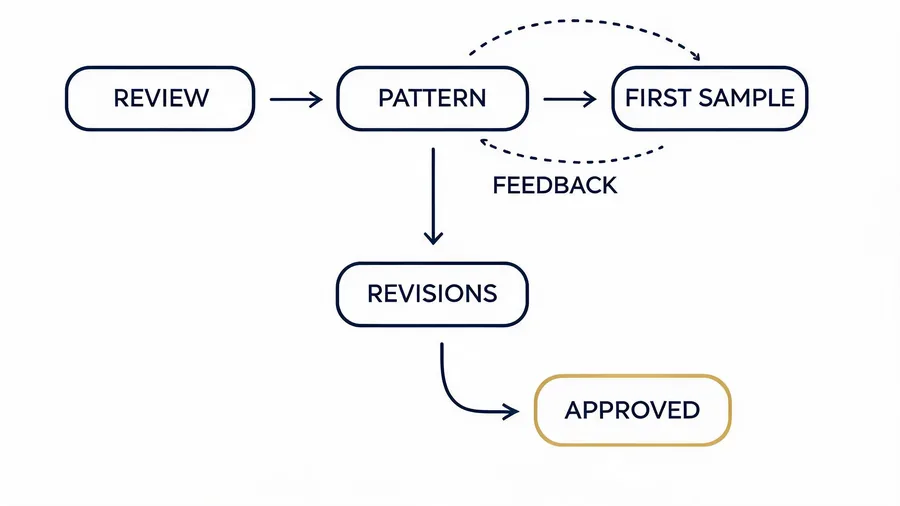
Sampling isn't one sample. It's a sequence, and each stage answers a different question.
Proto sample
The proto sample tests the concept. Shape, construction, initial dimensions. It's rough and it's supposed to be. You're checking whether the idea works in fabric.
Fit sample
The fit sample tests how the bag behaves on a person or in use. Strap geometry, access, ergonomics. A backpack that looks right on a table can be wrong on a shoulder.
Pre-production sample
The pre-production sample is made with the intended bulk materials and approved methods. This is where you find out whether the fabric you approved can actually be sewn the way the design requires.
Golden sample
The golden sample is the approved physical reference. It sits at the factory and at final inspection, and production is compared against it. If your golden sample is wrong, everything downstream is wrong, which is why the approval signature matters more than the sample itself.
Fabric and print approvals run in parallel. A lab dip is a small dyed material sample submitted for color approval before bulk. A strike-off is a printed sample used to approve artwork, color, scale, registration and print quality. Approve both before bulk starts. Approving color after the fabric is already dyed is an expensive conversation.
Expect samples to be paid. Expect one revision round as standard. Anyone offering free samples on a custom bag is either building the cost into the unit price or planning to recover it later.
Quality control and testing you can ask to see
Inspection runs on a sampling plan. AQL, the acceptance quality limit, is used with that plan to determine sample size and acceptance numbers. Defects get classified as critical, major or minor based on risk and product impact. The exact sampling values belong in your approved specification, not in a supplier's sales deck.
Common tests on fabric bags include seam strength, zipper cycling, abrasion resistance, colorfastness to rubbing, and water resistance. Each measures one property of one material or component.
Here is the trap. A material test result does not automatically become a finished-product claim. A coated fabric can pass a water-resistance test and the finished bag can still leak, because the seams and the closure were never tested as a construction. Use water-resistant only when the material or product has passed a defined method. Use waterproof only when the complete construction, including seams and closures, meets the stated waterproof conditions. Use leakproof only when the complete product passes a defined liquid-containment test.
Who pays for testing? Usually the buyer, unless it's part of an agreed production protocol. Ask before you assume. And keep approved reports linked to the exact material lot, component version and product revision, because a report for last season's fabric tells you nothing about this season's.
Fabric and hardware specifications that drive the price
Two quotes for the same bag can differ by a wide margin and both can be honest. The gap lives in the specification.
Start with weight and construction. Buyers see gsm, denier and ounce canvas on a spec sheet, and those numbers move price more than almost anything else. Heavier fabric costs more, sews differently, and changes how the bag drapes. If your spec sheet doesn't state the weight and the construction, you're not comparing quotes, you're comparing guesses.
Then coating and lamination. A PU or PVC coating, or a TPU lamination, changes water resistance and hand feel. Heat-welded seams and waterproof zippers change it again. Each addition has a cost, and each one should be justified by the use case, not added by default.
Hardware is the third lever. Zipper grade, webbing quality and buckle type affect durability and price. A cheap zipper on an otherwise good bag is the most common failure point buyers report. It's also the easiest place for a factory to shave cost without changing the visible design, so specify it explicitly.
MOQ is structured, not fixed. It moves by material, by color, and by logo process. A single-color order in a stock fabric behaves differently from a multi-color order in a custom weave. If you need a low MOQ, say so at the RFQ stage, because the answer depends on what you're asking for.
For category-specific spec guidance, see the garment bag wholesale guide and the wholesale duffle bags guide.
Turning a shortlist into a first order
Say a buyer has three factories on the shortlist and a budget that only allows one mistake. The RFQ is where you control the outcome.
Put the specification in the RFQ. Fabric weight and construction, dimensions with tolerances, hardware grade, logo method, packaging, target quantity and required ship window. When every supplier quotes against the same document, the numbers become comparable. When they quote against a paragraph, they become fiction.
Confirm terms in writing before the deposit: payment method, shipping mode, who handles the export documentation, and what happens if the goods fail inspection. After-sales should cover a response window, replacements, credits or technical support. Get the mechanism, not the promise.
Then run a small trial order. Not a sample. A production run at a size that tests the factory's real behavior: how they communicate, how they handle a defect, how they pack. A supplier that performs on a trial order is a supplier you can scale. A supplier that stumbles on a trial order will stumble harder on volume.
If you have a spec ready and want a quote against it, send it through the contact page.
Frequently Asked Questions
What is the difference between a fabric bag manufacturer and a trading company?
A manufacturer owns the production equipment and the people who run it: cutting room, sewing lines, sub-assembly stations, QC and packing. A trading company sells bags but subcontracts the work, so it controls price and communication but not the line. The practical difference shows up when something goes wrong. A factory can stop production and fix it. A trader can only relay the problem to a third party who has other clients waiting.
Which certifications should a fabric bag factory hold?
The ones worth asking for in this industry are amfori BSCI for social compliance, ISO 9001 for quality management systems, SGS and TUV for specific test reports, and GRS for recycled content chain of custody. Read the scope wording on each one. A certificate whose scope excludes bags, or names a different site than the one making your order, proves nothing about your order. Regulatory frameworks like CPSIA, REACH and GPSR are regulations, not certificates a factory holds, so treat any claim of being certified to them with caution and check current guidance from the relevant authority.
How does sampling work when you order custom fabric bags?
Sampling runs as a sequence. A proto sample tests the concept, shape and initial dimensions. A fit sample tests how the bag behaves in use, including strap geometry and access. A pre-production sample is made with the intended bulk materials and approved methods. The golden sample is the approved physical reference used at final inspection, so production is compared against it. Fabric and print approvals run alongside: a lab dip approves dyed color, and a strike-off approves printed artwork, color, scale and registration. Expect samples to be paid and one revision round as standard.
What should you check during a fabric bag factory audit?
Ask who owns the sewing machines, whether unannounced visits are welcome, and where the production floor actually is. Request a live video walkthrough, not a recorded clip, and name the stations you want to see: a cutting table with fabric spread, sewing lines with work-in-progress at multiple stages, a QC station with a measurement method and defect log, and a packing area with cartons and a scale. If the walkthrough only reaches a showroom and a meeting room, you are talking to a sales office rather than a factory floor.