Wholesale duffle bags are one of the most forgiving product categories to source. They're also one of the easiest to get wrong. A buyer ordering 800 units in three colors has to think about capacity, fabric, zipper gauge, handle anchoring and base reinforcement before the first sample gets cut. Miss one and the bag comes back with a claim. This guide walks through the decisions in the order a production team actually makes them.
Duffle Bag Types and Capacity Bands for Wholesale Buyers
Duffle bags split into a few recognizable families. Barrel duffles are the classic cylinder shape with a top zipper and two end pockets. Square or box duffles have a flat base and side panels, so they hold their shape on a shelf and pack like a small trunk. Weekenders are shorter, wider and built for two or three days of clothing. Gym duffles are compact, often with a separate shoe compartment. Travel duffles add a trolley sleeve that slides over a rolling suitcase handle. Wheeled duffles take that further and put wheels and a telescoping handle on the bag itself.
Capacity bands help a buyer sort these styles. A compact gym or day duffle usually runs around 20 to 30 liters. A weekender lands in the 30 to 50 liter range. Large travel and rolling duffles go above 50 liters. These are general bands, not promises. The finished dimensions control the real capacity. A 45 liter duffle can be tall and narrow or short and deep. The use case decides which shape works.
For bulk promotional and retail orders, the barrel and gym styles dominate. They're simple to sew, easy to print and forgiving on fabric yield. Weekenders and travel duffles with trolley sleeves cost more to produce because the back panel needs structure and the sleeve adds a second layer. Say a corporate buyer wants 2,000 giveaway bags. A barrel duffle in one color with a woven label is the sensible choice. A wheeled duffle is not.
Fabric Choices: 600D Polyester, Ballistic Nylon, Canvas and PU
600D polyester is the workhorse. It's cheap, dimensionally stable and takes printing well. Most promotional duffles use it. The fabric weight keeps the bag light, which matters when a buyer is shipping 5,000 units by sea. 600D is not the most abrasion resistant option. For a gym bag that gets dragged across locker room floors, it's fine. For a travel duffle checked through an airport, a heavier fabric earns its keep.
1680D ballistic nylon is the step up. It resists abrasion and handles heavier loads without tearing. The tradeoff is price and stiffness. A duffle in 1680D feels more rigid out of the box. It also costs more per meter. Buyers choose it for premium retail lines or team bags that need to survive years of use. Cotton canvas is the opposite direction. It has structure and texture and reads as natural or heritage. Canvas is heavier than polyester, absorbs moisture and costs more to print with fine detail. It's a positioning choice, not a performance upgrade.
PU coating changes the hand feel and the water resistance. A light PU coating on 600D polyester makes the fabric shed light rain and gives it a slightly slicker surface. A heavier coating or a TPU lamination moves the bag toward waterproof. The coating also affects price. Every gram of coating adds cost. A buyer should specify the coating weight, not just the fabric denier. Otherwise two suppliers can quote the same 600D polyester and deliver very different fabric.
Base Construction and Reinforcement Points
The base decides whether a duffle holds its shape or collapses into a puddle. A reinforced base panel with a plastic board or PE board insert keeps the bottom flat. It also protects the contents when the bag is set down hard. The board sits inside a fabric sleeve or is sewn between the outer shell and the liner. Without it, a loaded duffle sags in the middle and the side seams take more stress.
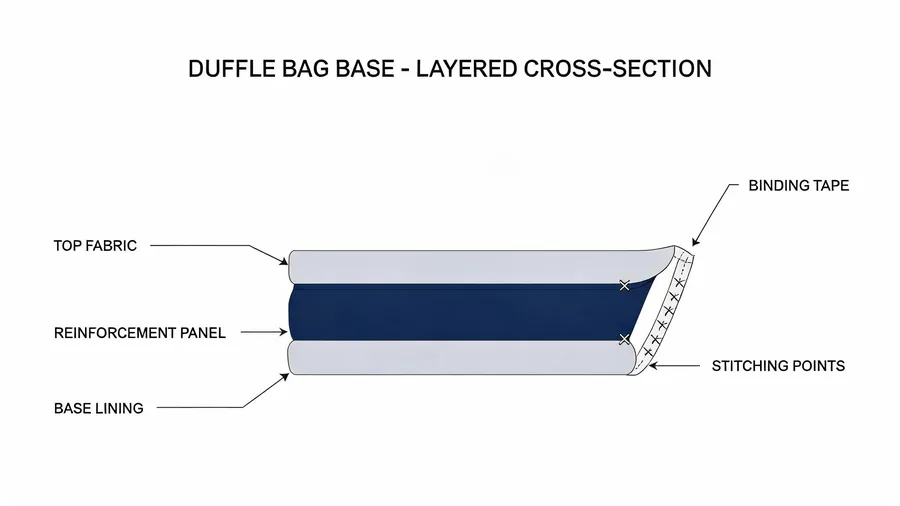
Reinforcement patches go at the high-stress seams. The corners where the base meets the side panels. The points where the handles attach. The ends of the zipper opening. A patch is an extra layer of fabric, usually the same shell material or a heavier webbing, sewn into the seam before the final assembly. It spreads the load across a wider area. Stitch density and seam allowance are the quality controls here. A supplier should state the stitch count per inch and the seam allowance in the specification. These are the numbers that separate a bag that lasts five years from one that fails in five months.
Handle and Shoulder Strap Anchoring: Where Duffles Fail First
Duffle handles take more abuse than any other component. A buyer picks up a loaded bag by one handle. The bag swings. The whole weight hangs on two small attachment points. If those points are not reinforced, the fabric tears. It's the most common failure we see in returned duffles.
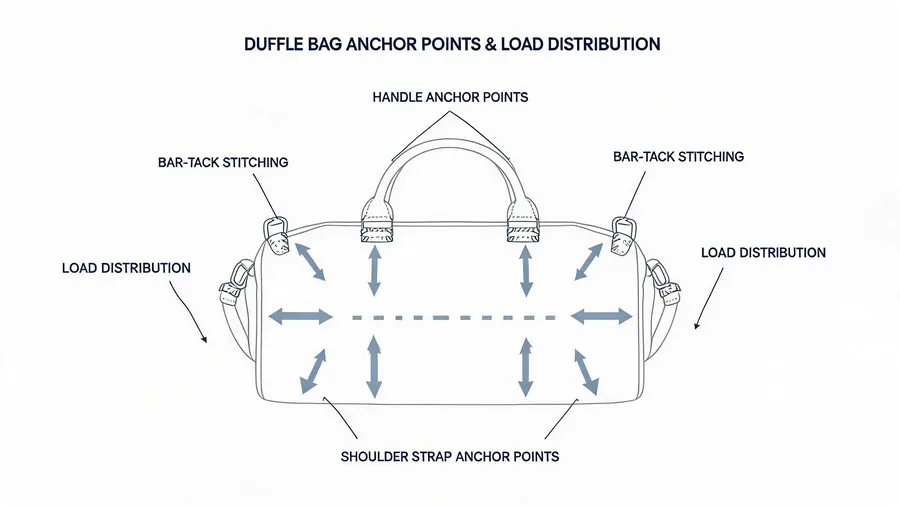
Handle drop matters. That's the vertical distance from the top of the bag to the inside top of the handle grip. Too short and the bag drags on the ground when carried by hand. Too long and it bangs against the legs. The drop should be specified in the tech pack, not left to the supplier's default. Bartacking is the standard reinforcement method. A bartack is a dense zigzag stitch that locks the webbing to the shell fabric. The more bartacks at each anchor and the longer each bartack, the stronger the connection. A box-X stitch is another option. It spreads the load over a rectangular area and is easier to inspect visually.
Adjustable shoulder straps add another failure point. The strap attaches to the bag with a metal or plastic clip, a D-ring or a sewn loop. The clip and D-ring should be rated for the maximum load the bag will carry. The sewn loop needs the same bartacking as the carry handles. A buyer should ask the supplier to photograph the strap anchor on the pre-production sample. If the bartack looks thin, it will fail.
Zipper Gauge, Slider Count and Opening Design
Zipper gauge is the width of the zipper teeth. A heavier gauge handles more load and more frequent opening. A lighter gauge is cheaper and runs more smoothly on a small bag. The gauge should match the use. A gym duffle opened twice a day can use a lighter zipper. A travel duffle stuffed to the brim and yanked open at an airport check-in needs a heavier one.
Slider count affects access. A single slider opens and closes from one end. A dual slider zipper has two pulls that meet in the middle, so the user can open the bag from either side and leave a gap in the middle for ventilation. Dual sliders cost a little more but make the bag feel more functional. The opening design matters just as much. A straight top zipper is the cheapest and simplest. A U-shaped opening runs around three sides of the bag and lets the user fold the top panel back like a lid. It's easier to pack but requires more zipper length and more careful sewing around the curves.
Waterproof zippers are an option for travel and outdoor styles. They use a coated tape and a tighter tooth profile to resist water entry. They also cost more and can feel stiffer to operate. A buyer should only specify a waterproof zipper if the bag is actually marketed as water resistant. Otherwise it's wasted money.
How MOQ, Colourways and Logo Process Interact in a Bulk Quote
Quantity, colourways and logo process are not three separate line items. They interact. A buyer who wants 500 units in one color with a woven label gets a different unit price than a buyer who wants 500 units in five colors with a metal plate. The first order lets the factory cut long runs of one fabric color and apply one label. The second order splits production into five dye lots and adds a metal component to each bag.
Colourways drive fabric yield. Every color change means the cutting table stops, the fabric rolls are swapped and the offcuts from the previous color are set aside. More colors means more waste and more setup time. Pantone matching adds another step. The supplier submits a lab dip, a small dyed sample, for approval before bulk production. The buyer approves it or sends it back. Every round of lab dips costs time. A buyer who insists on exact Pantone matching across five colors should expect a longer lead time than a buyer who accepts stock colors.
Logo process has its own material and labor cost. A woven label is sewn on and requires a minimum label order. A metal plate is riveted or screwed on and needs a mold. Heat-transfer PVC is printed and applied with heat. Laser engraving burns the logo into the fabric. Each process has a different setup cost and a different minimum quantity. The supplier should state these minimums per process, not as a blanket policy. For duffle bags specifically, exact MOQs vary by fabric and logo method. A buyer should ask for the number after the spec is fixed. Low MOQs are available, but the exact figure depends on the order.
Use-Case to Fabric, Size and Hardware Mapping
The table below maps common duffle use cases to the fabric, size band and hardware a buyer should consider. It's a starting point, not a fixed recipe. Every column can be adjusted once the target price is set.
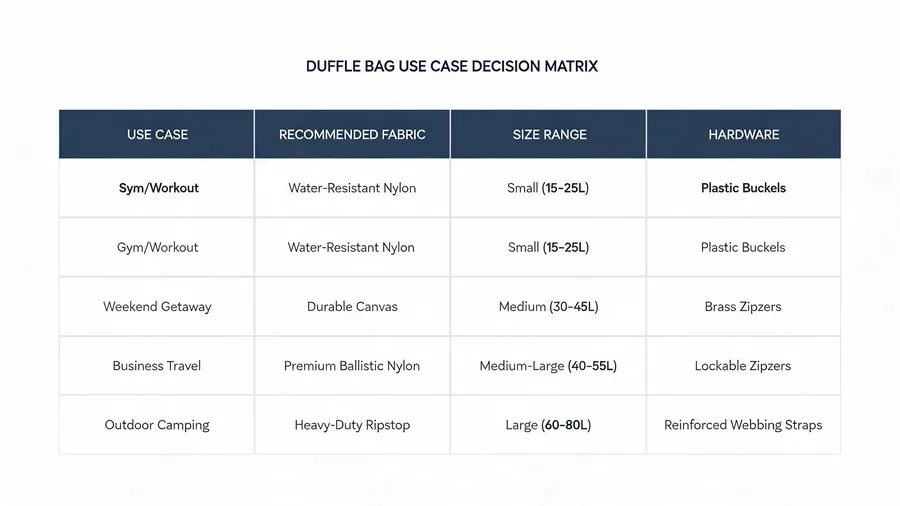
| Use case | Fabric | Size band | Hardware notes |
|---|---|---|---|
| Gym | 600D polyester | 20-30L | Light zipper, single slider, basic bartacked handles |
| Weekend travel | 600D polyester or canvas | 30-50L | Dual slider, U-shaped opening, reinforced base |
| Carry-on travel | 1680D ballistic nylon | 30-50L | Heavy zipper, trolley sleeve, waterproof option |
| Sports/team | 1680D ballistic nylon | 50L+ | Heavy zipper, box-X anchors, plastic board base |
| Promotional giveaway | 600D polyester | 20-30L | Light zipper, single slider, woven label |
Promotional giveaways trade durability for price. The bag needs to look good at an event and survive light use. A 600D polyester barrel duffle with a woven label fits. A sports team bag is the opposite. It gets thrown into vans, dragged across fields and loaded with wet gear. 1680D ballistic nylon, box-X anchors and a plastic board base are worth the extra cost. The tradeoff between price, weight and durability is different for every use case. A buyer should pick two of the three and let the third float.
Spec Fields to Send a Duffle Bag Supplier
A clear spec saves weeks of back-and-forth. Send these fields and the supplier can quote accurately on the first pass.
- Product name and intended use. One sentence. "Gym duffle for retail, target user 18-35, max load 12 kg."
- Finished dimensions. Height, width and depth with measurement points and tolerances. A dimension diagram is better than words.
- Capacity in liters and the method used to measure it.
- Material composition. Fabric, denier or GSM, coating type and weight, lining material, foam thickness if any.
- Approved color. Pantone reference or a physical color standard.
- Bill of materials. Every component listed with size, finish and color. Zipper gauge, slider count, webbing width, hardware type, base board material.
- Artwork dimensions and placement. Logo size, position, process and durability requirement.
- Packing method. Polybag, carton quantity, carton marks and any shipping test requirements.
Most of these fields come straight from the tech pack. If a buyer doesn't have a tech pack, the supplier should help build one from the answers. The important thing is to write the answers down. A verbal spec is not a spec. It's a guess.
A buyer who sends a complete spec gets a faster quote and a more accurate sample. A buyer who sends a photo of a competitor's bag and says "make this cheaper" gets a long email chain. The difference is the spec.
We've covered the main decisions. Fabric, base, anchors, zipper. Get those right and the duffle does its job. Get them wrong and the bag comes back. If you're sourcing duffles alongside other categories, the same logic applies to cooler bags and woven bags. The spec fields are the same. The materials change. For more on building a spec across categories, start with the contact page and tell us what you're planning.
Frequently Asked Questions
Where can I buy bulk duffel bags?
Bulk duffel bags come from bag manufacturers, trading companies and wholesale marketplaces. A manufacturer gives you direct control over fabric, size and logo. A trading company may offer lower minimums but less transparency on production. Ask any supplier for their factory address, a pre-production sample and the spec sheet before you commit.
Where can I buy a cheap duffle bag?
Cheap duffle bags are usually 600D polyester with a light zipper and simple handles. The price drops when you order more units, use stock colors and keep the logo to a woven label. Watch the handle anchors and the base. Those are the first places a cheap bag fails.
What is the difference between a duffle bag and a weekender bag?
A weekender is a type of duffle. It's shorter, wider and sized for two or three days of clothing, usually 30 to 50 liters. A general duffle can be larger or smaller. The weekender often has a flat base and a U-shaped opening, while a barrel duffle keeps the classic cylindrical shape.
What should a wholesale buyer check before ordering custom duffle bags?
Check the fabric denier and coating weight, the zipper gauge and slider count, the handle anchoring method and the base reinforcement. Ask for a dimension diagram with tolerances and a pre-production sample. Confirm the MOQ for each color and logo process before you approve the quote.