Compression Packing Bags and Custom Packing Cubes
Wholesale luggage organizer sets in durable nylon, configured to your piece count, sizes and branding.
Overview
Packing cubes are one of the fastest-growing accessories in travel retail, and we build them as configurable sets rather than fixed SKUs. Our reference 9-piece travel organizer set pairs four cube sizes with toiletry, shoe, laundry, zippered and electronics bags, all in wrinkle-resistant nylon with two-way YKK zippers.
MOQs are flexible on this category: tell us your target quantity and configuration and we will confirm feasibility.
Representative styles
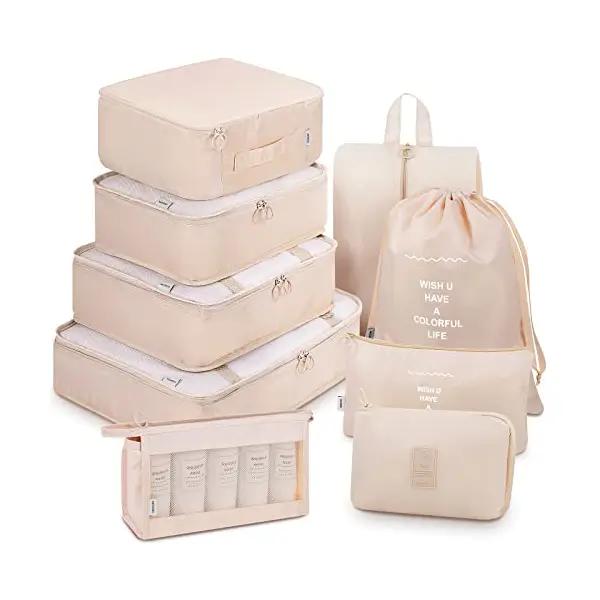
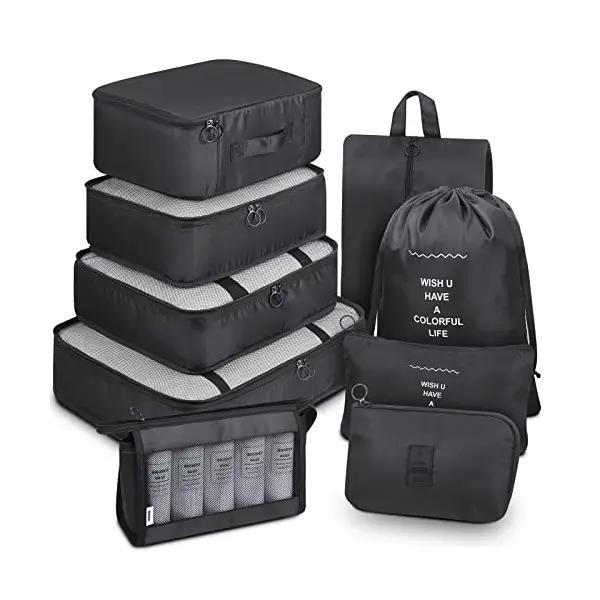
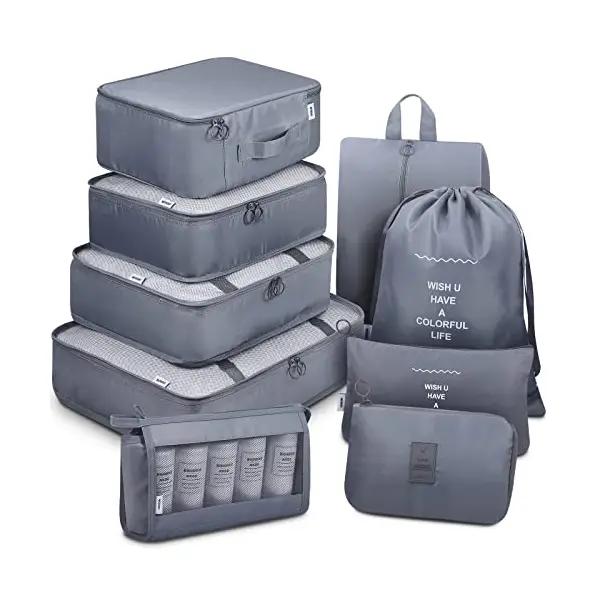
Shown styles are from our production lines; every program is built to your design, materials and branding.
Specifications
| Reference product | 9-Piece Travel Organizer Set (A-4618), nylon |
|---|---|
| Packing cube sizes | Extra Large 16.5″ × 12.6″ × 4.7″ · Large 13.5″ × 11.5″ × 4.7″ · Medium 12.6″ × 9.5″ × 4.7″ · Small 11.5″ × 8.4″ × 4.2″ |
| Set companions | Toiletry bag 10.2″ × 6.2″ × 3″, zippered bag 10.5″ × 6.2″, shoe bag 13.8″ × 9.7″, drawstring laundry bag 13.8″ × 10.7″, electronics bag 9″ × 5.9″ |
| Set lead time | 1-200 pieces: 25 days · 201-500 pieces: 30 days · above 500: negotiated |
MOQ and lead times
| MOQ | Low MOQs, contact us |
|---|---|
| Sampling | 1-10 days, paid samples; one revision round in 2-3 days |
| Production | reference set: 25 days up to 200 pcs, 30 days up to 500 pcs |
| Rush options | +20% fee cuts lead time 30%; +30% cuts 50%; +40% cuts 70% |
| Shipping | Sea, rail or air; courier door to door in 5-7 working days for small lots; sea freight 40-45 days |
Go deeper
For the full organizer program including compression styles and set builders, visit our dedicated site, custompackingcubes.com.
Materials and Construction Options for Compression Packing Bags
Compression packing bags live or die by their shell fabric and their liner. The shell takes abrasion from luggage interiors and overhead bins. The liner controls how cleanly clothes slide in, and how much moisture reaches the contents. Most buyers start with the shell and work inward.
Polyester is the default for a reason. It is dimensionally stable, prints well, and comes in weights from featherlight to heavy. A buyer who wants a cube that holds a sharp crease under a full load will pick a heavier polyester with a firm hand. The tradeoff is weight and packability. Nylon costs more but gives better tear resistance at a lower weight. For cubes that get yanked out of a suitcase by the handle, nylon webbing and shell panels hold up longer.
Canvas and cotton duck are niche choices. They look premium, they age visibly, and they add structure without foam. But they are heavier, slower to dry, and they can transfer color if the dye lot is not controlled. A brand selling a heritage travel line might accept that. A brand selling ultralight backpacking cubes will not.
Ripstop fabric deserves its own mention. The reinforcement grid stops small punctures from turning into long tears. It is the right call for cubes that will be overpacked repeatedly. Mesh is common on the top panel for visibility, but it is a compromise. Mesh lets air through, which is good for laundry, but it does nothing for compression. The compression force comes from the zipper and the gusset, not from the mesh.
The liner is where buyers make expensive mistakes. A cheap nonwoven liner feels fine in a sample and pills after a season. A PEVA film liner is easy to wipe clean and blocks moisture, but it can crack in cold weather. A PU-coated liner is softer and quieter, but the coating weight has to be specified or the supplier will choose the cheapest option that still looks like a liner. The table below lays out the realistic choices.
| Material | Good for | Where it fails |
|---|---|---|
| Polyester fabric | Print quality, dimensional stability, wide weight range | Lower tear strength than nylon at equal weight |
| Nylon fabric | Strength to weight, abrasion resistance | Higher cost, more stretch under load |
| Ripstop fabric | Tear propagation control, overpacking | Grid pattern visible through light colors |
| Canvas / cotton duck | Premium hand feel, structure, heritage look | Weight, drying time, colorfastness control |
| Mesh | Ventilation, visibility, stretch pockets | No compression contribution, snags |
| PEVA film liner | Wipe-clean, moisture barrier, low cost | Cracks in cold, stiff hand feel |
| PU-coated liner | Soft hand, quieter, better drape | Coating weight must be specified or quality drops |
Say a buyer wants a cube that feels expensive but retails under twenty dollars. Polyester shell, PU-coated liner, and a mesh top panel get there. Say another buyer needs a cube for wet swimsuits and gym gear. That buyer should skip the mesh and look at a PEVA liner with welded seams. The material decision is never about one property. It is about which failure the buyer can afford.
How Buyers in Different Situations Should Specify This Product
A buyer who sells direct to consumer through Instagram cares about the unboxing moment. The cube has to look full and structured in a flat lay. That means a wide compression gusset, typically several centimeters when open, tailored to the product size. The shell needs enough body to hold the compressed shape, not collapse into a wrinkled puddle. A buyer in this situation should specify a heavier polyester or a nylon with a firm coating, and should ask for a sample that has been compressed and reopened twenty times before approving.
A buyer who supplies corporate travel programs has a different problem. These cubes get washed. Or they get wiped down with disinfectant wipes between trips. The specification that matters is the liner's cleanability and the zipper's resistance to snagging. A coil zipper with a smooth tape is easier to wipe than a molded tooth zipper. The liner should be specified as wipe-clean, not just water-resistant. And the compression zipper needs a puller that can be operated with one hand while the other hand holds the cube.
A buyer who sells through Amazon faces return rates. The number one return reason for packing cubes is not a broken zipper. It is a cube that does not compress as much as the listing photos suggest. That buyer should specify the compression ratio in the product data, not just in the marketing copy. The factory needs a defined test method for measuring compressed height versus open height. Without that, the buyer is guessing. The compression gusset can be narrower, adjusted to meet the cost target, but the buyer has to know what number they are promising the customer.
Each of these buyers is buying the same product category. They are not buying the same product. The specification sheet is where the difference gets written down.
Customization That Changes Tooling, Cost or Lead Time
Most packing cube customization is surface-level. A printed logo on the shell, a woven label, a colored zipper tape. These changes do not touch the pattern. They add cost per unit, but they do not add tooling, and they do not delay production by more than a day or two. A buyer who wants a branded zipper puller is in a different category. A custom zipper puller with a brand logo is a new mold. The mold cost is one-time, but it adds lead time. The buyer pays for the mold, then pays for the pullers, then waits for the pullers to arrive before assembly can start.
A custom printed fabric with a proprietary pattern is not tooling, but it requires strike-offs and color approval, which adds time for approvals. The buyer has to sign off on the print registration, the color match, and the fabric hand before cutting starts. That is not a cost to skip. A bad strike-off approved in a hurry becomes ten thousand cubes with a blurry logo.
Pattern changes are the expensive ones. If a buyer wants a different gusset width, a different zipper placement, or a different panel shape, the pattern has to be revised. Pattern revision means a new sample, a new fitting, and a new approval cycle. That adds time for a new sample and approval cycle before production can start. It also means the cutting dies change. For a simple cube, the die might be a simple steel rule die. For a complex cube with multiple panels and a curved gusset, the die cost goes up.
Buyers who want a fully custom cube, with a new size, a new panel map, and a new compression system, should expect a longer timeline from approval to shipment. The factory has to draft the pattern, cut a first sample, fit it, revise it, and cut a second sample. Only then does production tooling get made. This is not a bad thing. It is how a cube becomes a product instead of a prototype.
The honest way to think about it is this. Surface customization changes the price. Tooling customization changes the timeline. Pattern customization changes both. A buyer who knows which bucket their request falls into can plan their launch date without surprises.
What to Check Before Approving Production for This Category
The specification checklist for packing cubes starts with dimensions. Height, width, and depth have to be measured the same way every time. A cube measured flat will not match a cube measured stuffed. The buyer should define the measurement condition. Is the cube empty and laid flat? Is it filled with a standard load? Is it compressed or open? If the buyer and the factory do not agree on this, every inspection becomes an argument.
The compression zipper is the highest-failure component. The buyer should ask for a defined water-resistance test on the liner and write the acceptance limit into the specification. The zipper itself should be tested for open-close cycles. A cube that is compressed and released a hundred times in a sample room is not the same as a cube that gets compressed and released a thousand times in a suitcase. The buyer should define the cycle count and the acceptance condition.
Claim control matters here more than in most categories. A claim like "compresses significantly" is meaningless without a defined test method and an acceptance limit. The buyer should write the claim into the specification, then write the test that proves it. If the claim is about volume reduction, the test measures volume. If the claim is about height reduction, the test measures height. The two are not the same thing.
Seam strength is the other silent killer. The compression zipper pulls the top and bottom panels toward each other. That puts the side seams under constant tension. A seam that holds fine on a non-compression cube can fail on a compression cube because the load is different. The buyer should specify a seam strength test on the compression gusset, not just on the main body seams.
Finally, the buyer should check the packing method. Packing cubes are soft goods. They get folded, stacked, and stuffed into cartons. If the carton is too small, the cubes arrive with permanent creases. If the polybag is too thin, the zipper pullers poke through and scratch the shell. The buyer should specify the polybag thickness, the carton quantity, and the folding method. These details are boring. They are also why a cube that looks perfect in a sample arrives looking like a used product.
For buyers comparing suppliers, the questions above separate a factory that makes packing cubes from a factory that understands them. The first factory will quote a price. The second factory will ask how the cube will be measured, tested, and packed. That second conversation is the one worth having. Our team works through these same points on every order. If you are still comparing options, the contact page has the details, and the ready-to-ship range shows how we handle stock items. Buyers who also carry garment bags or diaper bags can find the same approach on those pages.
FAQ
What is the MOQ for custom packing cubes?
Low MOQs, contact us with your target quantity and we will confirm what works for your set configuration.
What sizes are in the 9-piece set?
Four packing cubes from 16.5 by 12.6 by 4.7 inches down to 11.5 by 8.4 by 4.2 inches, plus toiletry, zippered, shoe, laundry and electronics bags.
Can sets be customized?
Yes. Piece count, sizes, colors and logo placement are all configurable; the 9-piece set is a starting reference.
How long does production take?
For the reference set: 25 days up to 200 pieces, 30 days up to 500, larger volumes negotiated.