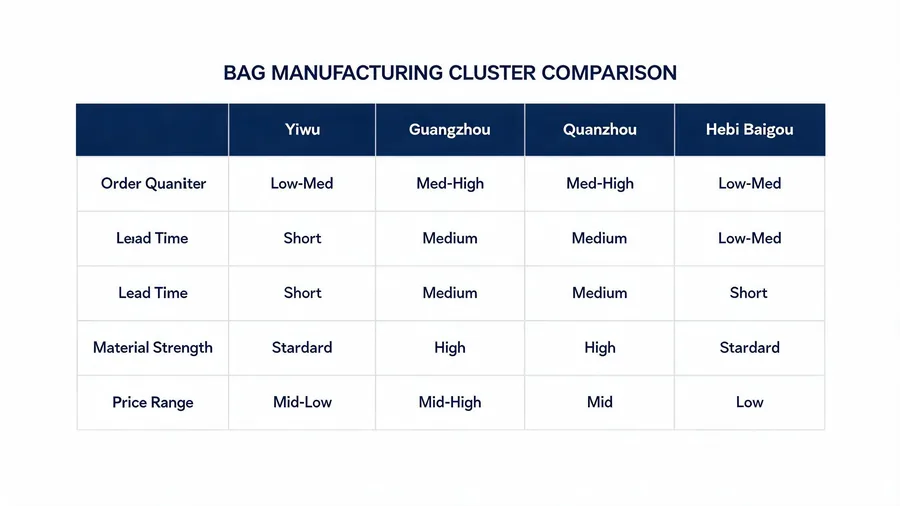
Bag manufacturers in China are not one category. They are a loose collection of regional clusters, each with different machinery, material access, labor skills and order logic. A factory that makes 50,000 polyester backpacks a month in Quanzhou may be useless for a 300-piece woven bag order. A Yiwu trading company can quote any category but owns no production line. You need to know which kind of supplier you are actually talking to.
This shortlist is built for sourcing managers and brand owners who want to cut down the first two weeks of supplier research. It explains what separates factories on paper, then walks through the main manufacturing regions and what each one does well. No invented company names. No fake revenue figures. Just the structural facts that matter when you send an RFQ.
What Actually Separates Bag Factories
Most factories look identical on a website. The real differences show up in four places.
Audit status comes first. A BSCI or ISO 9001 certificate tells you the factory has passed a third-party social or quality management audit. It does not tell you the bags are good. It tells you the factory is organized enough to be checked. That matters when your retail buyer asks for compliance paperwork. Ask for the certificate number and verify it on the issuing body's site. A factory that hesitates is not worth the next call.
Sampling speed is the second filter. A factory with in-house pattern makers and a sample room can turn a proto sample in days. A trading company sends your design to a third factory and waits. The difference shows up in your development calendar. If a supplier quotes three weeks for a simple cosmetic bag sample, you are not talking to a factory.
Fabric supplier depth is the third. A backpack factory that works with 200+ fabric suppliers can switch from 600D polyester to rPET canvas without stalling. A small workshop buys from one local market and quotes whatever the stall has that week. Ask where the fabric comes from. The answer tells you how much control you have over your own bill of materials.
MOQ flexibility is the last one. Some factories will run 500 pieces per color. Others want 5,000. Neither is wrong. The wrong part is hiding the real number until after you have spent two weeks on a tech pack. Get the MOQ in writing on the first call.
Yiwu, Zhejiang
Yiwu is the small leather goods and cosmetic bag capital. The city runs on low MOQs and fast turnover. Factories here are set up for short runs, mixed colors and quick sampling. A typical order might be 500 cosmetic bags in three colors with a one-week sample. That is normal here and impossible in some other clusters.
The trade-off is depth. Yiwu factories are not the first choice for technical backpacks with molded foam and load-bearing frames. They are the first choice for makeup bags, simple totes, cooler bags and promotional items. The supply chain around Yiwu is built for speed, not heavy engineering.
Our own operation sits here. Camytonc is a Yiwu-based bag brand developed by Wingtu, with a BSCI-certified factory, over 500 workers and 150,000 units of monthly output. We focus on cosmetic bags, cooler bags, backpacks and woven bags. That is a narrow range on purpose. You cannot be good at everything.
Guangzhou Baiyun District
Baiyun is where the leather and PU bag trade lives. The district has thousands of workshops and mid-size factories making handbags, wallets, crossbody bags and fashion backpacks. The labor pool is experienced in cutting, edge painting, hardware setting and finishing work that requires a steady hand.
If your line is fashion-forward and uses PU, microfiber or bonded leather, Baiyun is the logical first stop. The material markets are dense and the hardware suppliers are a short motorbike ride away. MOQs run higher than Yiwu for simple items but lower than you would expect for a region with this much specialization. Sample rooms are everywhere. Quality varies wildly, so the audit point above matters even more here.
Quanzhou, Fujian
Quanzhou builds technical backpacks, sports bags and school bags. The factories are larger, more automated and more comfortable with multi-panel constructions, padded laptop compartments, sternum straps and load-bearing stitching. This is the region you call when the bag has to survive a school year or a trail.
MOQs are higher. A 500-piece backpack order is small here. The factories want 1,000 to 3,000 pieces and often more. But the engineering is real. In-house pattern rooms, cutting tables, computer-controlled sewing lines. If your spec sheet runs to six pages, Quanzhou will not blink.
Hebei Baigou
Baigou is the volume luggage and bag cluster. It produces an enormous share of China's suitcases, trolley bags, duffels and basic backpacks. The advantage is cost at scale. The disadvantage is that Baigou is not known for delicate finishing or complex custom work.
Think of Baigou for a 10,000-piece duffel bag program where the design is fixed and the price is the main lever. Do not think of Baigou for a 200-piece woven bag with leather trim and hand-finished edges. The supply chain is not built for that.
Comparison at a Glance
| Region | Known For | Typical MOQ Feel | Best Fit |
|---|---|---|---|
| Yiwu, Zhejiang | Cosmetic bags, cooler bags, simple totes | Low, 300-500 pcs | Fast sampling, mixed colors, promotional runs |
| Guangzhou Baiyun | PU and leather handbags, fashion backpacks | Medium | Fashion-forward lines with hardware focus |
| Quanzhou, Fujian | Technical backpacks, school bags, sports bags | Higher, 1,000+ pcs | Engineered designs, padded compartments |
| Hebei Baigou | Luggage, duffels, basic backpacks | High volume | Cost-driven programs, fixed designs |
How to Shortlist Without Wasting a Month
Start with your category. If you are buying woven bags, do not email a Quanzhou backpack factory. They will quote it, but the price will be wrong and the sample will be late. Go to the cluster that already makes your product every day. That is the single biggest time saver in Chinese sourcing.
Then send the same RFQ to three factories in the right cluster. Same tech pack, same quantities, same target price. Compare the questions they ask. A factory that asks about seam allowances, zipper brands and packing density is engaged. A factory that replies in two hours with a price and nothing else is quoting blind.
Finally, ask for the audit certificate and one reference order in your category. Not a client name. A description: last month we ran 2,000 cooler bags for a US distributor. That is enough. If they cannot describe a recent relevant order, move on.
You can read more about our own product categories or see how we handle backpack development and cooler bag construction. The contact page has the fastest route to a real answer.
One Honest Note
Camytonc is one option among many. We are strong in cosmetic bags, cooler bags, backpacks and woven bags. We are not the right factory for a 20,000-piece hard-shell luggage program. You should shortlist three suppliers in the right cluster, send the same RFQ and compare. If our categories match your line, we will answer fast and tell you what is actually possible. That is the whole job.
Frequently Asked Questions
Which region in China is best for small bag orders?
Yiwu in Zhejiang is the most flexible for small orders. Cosmetic bags, cooler bags and simple totes often start around 500 pieces per color. Sampling is fast and mixed color runs are normal. For leather or PU fashion bags, Guangzhou Baiyun is the next stop, though MOQs run a little higher.
What is a realistic MOQ for custom backpacks in China?
It depends on the region. Quanzhou factories typically want 1,000 pieces or more for a technical backpack. Yiwu suppliers may accept 500 pieces for a basic backpack with embroidery, but special fabrics can push that to 1,000. Always get the MOQ in writing before you invest in a tech pack.
How do I verify a Chinese bag factory's audit certificate?
Ask for the certificate number and the issuing body. BSCI and ISO 9001 certificates can be checked on the auditor's public database. A factory that shares the number immediately is usually legitimate. A factory that sends a scanned logo without a number is not verified.
What is the difference between a bag factory and a trading company?
A factory owns the production line, sample room and usually the material sourcing. A trading company coordinates between you and one or more factories. Trading companies can quote any category but add a margin and slow down sampling. Ask who makes the sample. If the answer is a third party, you are talking to a trader.