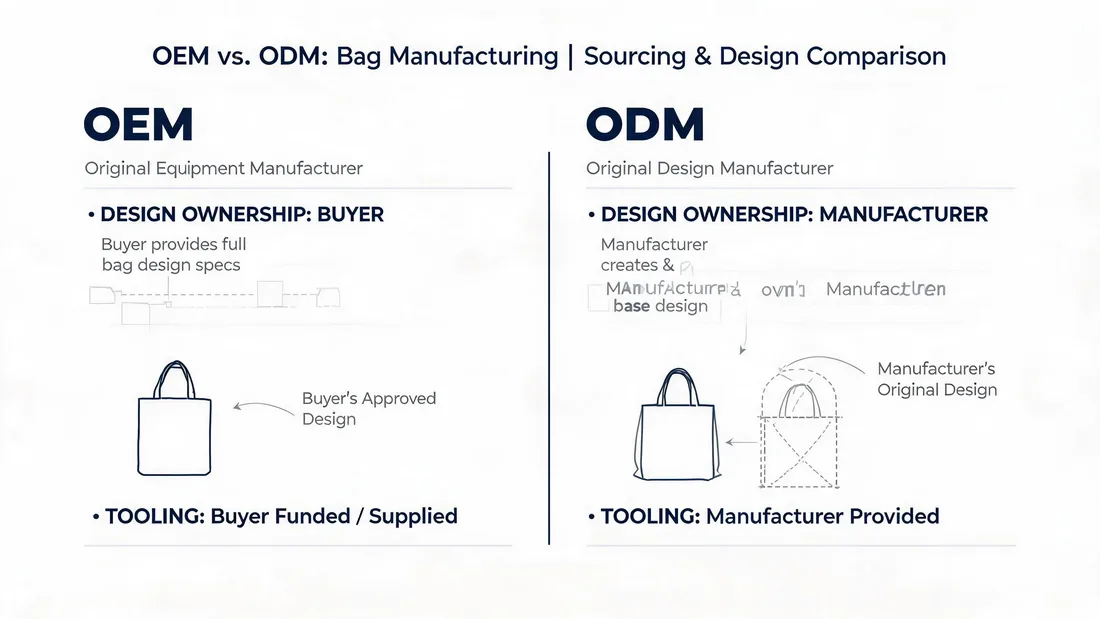
OEM and ODM bag manufacturing sound similar. They are not. One gives you full design control and a longer runway. The other gets you to market fast with someone else's proven pattern. If you're a brand owner, sourcing manager, or procurement buyer, the wrong choice costs you time, money, or both.
Let's define both terms in the bag context, then compare them on the things that actually matter: design ownership, tooling and pattern costs, sample speed, minimum order quantities, IP, and what happens when you scale.
What OEM Bag Manufacturing Actually Means
OEM stands for Original Equipment Manufacturer. In bags, that means you bring the design. You own the concept, the dimensions, the material direction, the logo placement, the hardware choice. The factory engineers your design into a production-ready product.
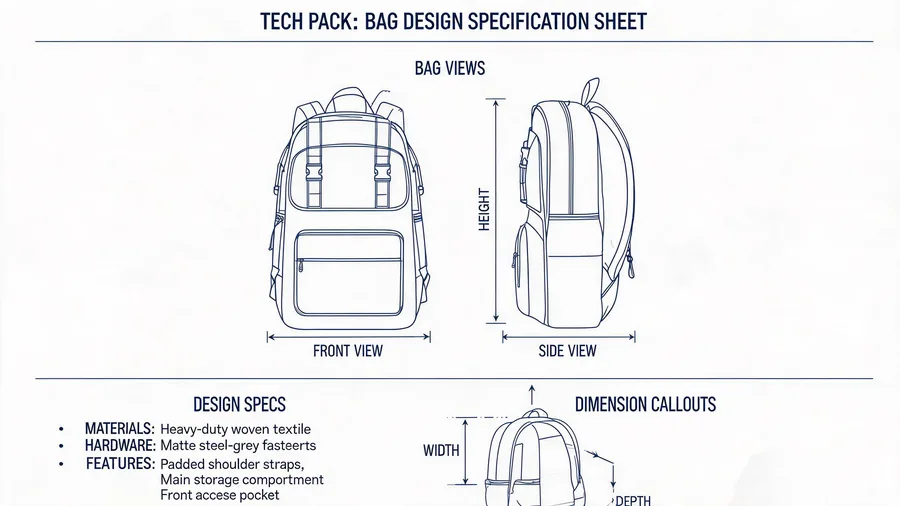
You'll need a tech pack or at least a clear specification sheet. That document controls dimensions, materials, construction details, artwork, labels, packaging, and test requirements. A bill of materials follows. The factory may suggest adjustments for manufacturability, but the design remains yours.
Tooling is the hidden cost here. If your bag needs a custom buckle, a molded zipper pull, a die-cut foam shape, or a new pattern, you pay for that tooling. Pattern development is also yours. The factory's pattern team converts your concept into cutting files and sewing sequences, but those files exist for your product only.
Speed to first sample is slower. Expect a proto sample first, then a fit sample if the bag is worn, then a pre-production sample made with bulk materials. Each round takes days. That's normal. Rushing this stage creates expensive mistakes at 5,000 units.
What ODM Bag Manufacturing Actually Means
ODM stands for Original Design Manufacturer. The factory owns the design. You select from an existing catalog or ask for minor modifications like color, fabric, logo, or a pocket change. The factory has already done the pattern work, sourced the materials, and often built the product before.
That changes everything about speed and cost. No pattern development. No tooling for standard components. The factory may already hold the fabric in stock. You can see a sample within days, not weeks, because it already exists.
The trade-off is ownership. You don't own the design. Another brand can order the same bag with a different logo. If you're building a long-term brand identity around a unique silhouette, ODM limits you. If you're testing a market or filling a seasonal gap, ODM is the rational choice.
OEM vs ODM: The Decision Table
Here's the comparison buyers ask about most.
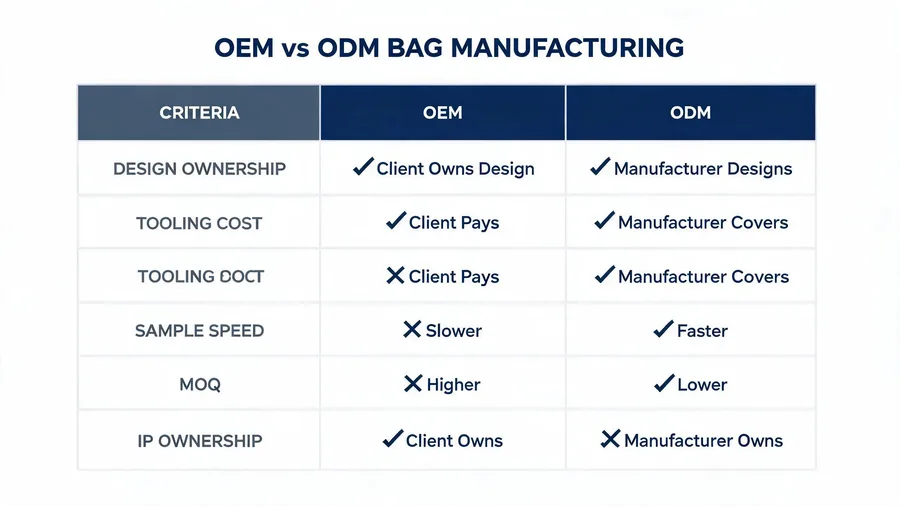
| Factor | OEM | ODM |
|---|---|---|
| Design ownership | Brand owns the design | Factory owns the design |
| Tooling and pattern costs | Brand pays for custom tooling and patterns | Usually none; factory has already amortized costs |
| Speed to first sample | Slower; multiple sample rounds | Fast; existing sample or minor revision |
| MOQ implications | Often higher for custom materials and hardware | Lower; factory can pool materials across buyers |
| IP protection | Strong if you control the tech pack and file ownership | Weak; design is shared |
| Scaling | You can move the design, but tooling may be factory-specific | You stay with the factory that owns the design |
Neither column is "better." The right column depends on your business stage and what you're trying to protect.
How the 8-Step Process Works at Camytonc
We run one documented process for both OEM and ODM, with different time implications at each step. Here's the standard flow at Camytonc, with the day ranges we commit to.
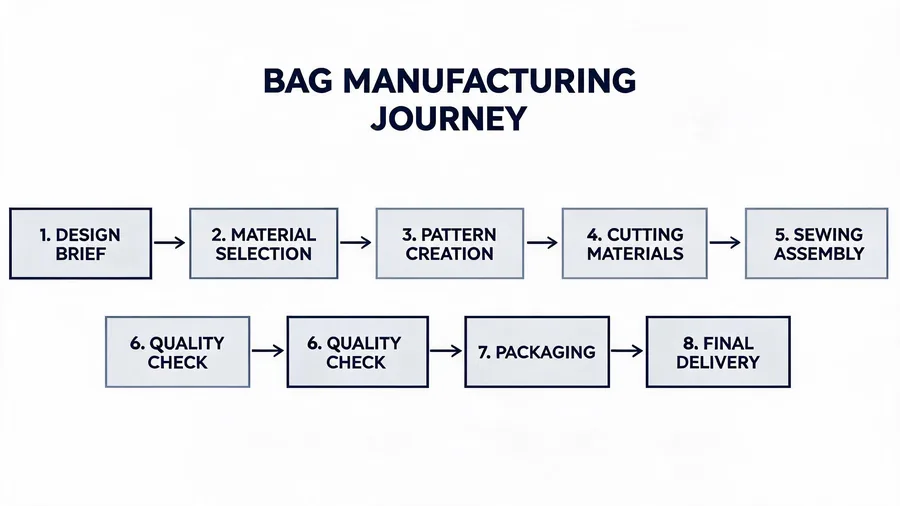
Step 1: Inquiry and confirmation (1-3 days)
You send your brief, tech pack, or the ODM catalog reference. We confirm what's possible and what needs clarification.
Step 2: Quotation and contract (1-2 days)
Pricing, terms, and the specification are locked. For OEM, this includes any tooling line items. For ODM, it's usually a unit price only.
Step 3: Sampling (5-7 days)
OEM starts with a proto sample. ODM starts with an existing sample or a revision. This is where the speed gap shows.
Step 4: Material sourcing (3-5 days)
OEM often requires custom fabric dyeing or hardware sourcing. ODM pulls from stock or established supplier lines.
Step 5: Mass production (15-20 days)
Same production floor, same quality checks. The difference is whether the pattern was proven before you arrived.
Step 6: Quality inspection (2-3 days)
Inspection against the approved specification, workmanship standard, and any agreed performance tests. Defect classification follows critical, major, minor severity.
Step 7: Packing (2-3 days)
Your packaging option, from poly bag to gift box to branded mailer.
Step 8: Shipping
Sea, rail, air, or door-to-door express. Small batches go DHL, FedEx, UPS, or TNT in 5-7 working days. Sea freight runs 40-45 days.
Read the full breakdown on our OEM/ODM process page.
Three Buyer Scenarios
1. The startup testing a design
You have a sketch for a modular backpack. You think it's different. You want 300 units in two colors. Go OEM, but only if you can accept the sample rounds and a higher per-unit cost at that volume. If cash is tight, consider an ODM base and add one custom feature. Don't pretend a catalog bag is your invention. Buyers can tell.
2. The established brand needing capacity
You already sell 20,000 units a year. Your designs are locked. You need a second factory or a better price. This is pure OEM. You'll send your tech pack, golden sample, and approved color standards. Expect a pre-production sample before bulk. Protect your files. Make sure the contract says who owns the pattern and any tooling you paid for.
3. The promotional distributor needing speed
You need 1,000 branded cooler bags for a client event in six weeks. Nobody cares if the bag is unique. They care that it arrives on time with the right logo. This is ODM. Pick an existing cooler bag, add the logo, and ship. You'll save three weeks versus a custom design.
IP Ownership: The Part Buyers Skip
OEM gives you design ownership, but only if the paperwork says so. A factory can build your bag and still claim the pattern file if the contract is silent. That's not paranoia. It's a standard sourcing risk. Specify file ownership, tooling ownership, and whether the factory can show your product to other buyers.
ODM is the opposite. You're licensing the factory's design for your order. You can trademark your logo and your brand name, but you can't stop the factory from selling the same bag shape to someone else. If exclusivity matters, negotiate it before you order. Some factories will agree to regional or time-limited exclusivity for a higher MOQ or a fee. Get it in writing.
For more on how we handle specifications and change control, see our about page.
What Happens at Scale
At 500 units, ODM looks cheap and fast. At 50,000 units, the math shifts. Custom tooling amortizes. Your material costs drop. Your design becomes a defensible asset. That's when OEM pays back.
But scale also exposes process weaknesses. A factory that's great at ODM catalog production may struggle with complex custom construction. A factory that's great at OEM prototyping may be slow on repeat orders. Ask about monthly capacity, not just unit price. We run 150,000 units monthly across 50+ automated production lines, with 30,000+ square meters of factory space. That capacity serves both models.
One more thing. Don't confuse OEM with "cheap." It's not. It's expensive up front and cheaper later. ODM is the opposite. Cheap to start, expensive in opportunity cost if you wanted a unique brand. Pick based on what you're building, not what feels safe this week.
Ready to talk specifics? Check our product categories or contact us with your brief.
Frequently Asked Questions
Can I switch from ODM to OEM later?
Yes. Many brands start with ODM to test a market, then invest in OEM once they have sales data. The key is keeping your logo and packaging consistent so the transition doesn't confuse your customers.
Who pays for tooling in OEM bag manufacturing?
The brand pays. Tooling includes custom molds, dies, patterns, and sometimes specialized sewing fixtures. The factory should itemize these costs in the quotation so you know what you're paying for.
Is ODM bag manufacturing lower quality than OEM?
No. The quality depends on the factory's standards, not the business model. A well-run ODM factory can produce excellent bags. The difference is design ownership, not stitching quality.
How do I protect my design when working with an OEM factory?
Use a written agreement that specifies design ownership, file ownership, tooling ownership, and confidentiality. Send your tech pack with a clear revision history. Keep the golden sample as your reference for disputes.
Frequently Asked Questions
What's the real difference between OEM and ODM bag manufacturing?
OEM means you own the design and the factory builds to your specification. ODM means the factory owns the design and you select or modify from their catalog. The difference shows up in cost, speed, and who controls the product.
Which is cheaper for a small brand, OEM or ODM bags?
ODM is usually cheaper to start because there are no tooling or pattern costs and MOQs are often lower. OEM costs more up front but gives you a unique product you can defend as your brand grows.
How long does OEM bag sampling take compared to ODM?
OEM sampling typically takes longer because it starts with a proto sample and may include fit and pre-production rounds. ODM sampling can be as fast as pulling an existing sample and changing the color or logo.
Can I order a small quantity for my first OEM bag order?
It depends on the factory and the materials. Custom fabrics and hardware often push the MOQ up. Some factories will accept a smaller order if you pay a surcharge or use stock materials. Ask before you commit to a design.