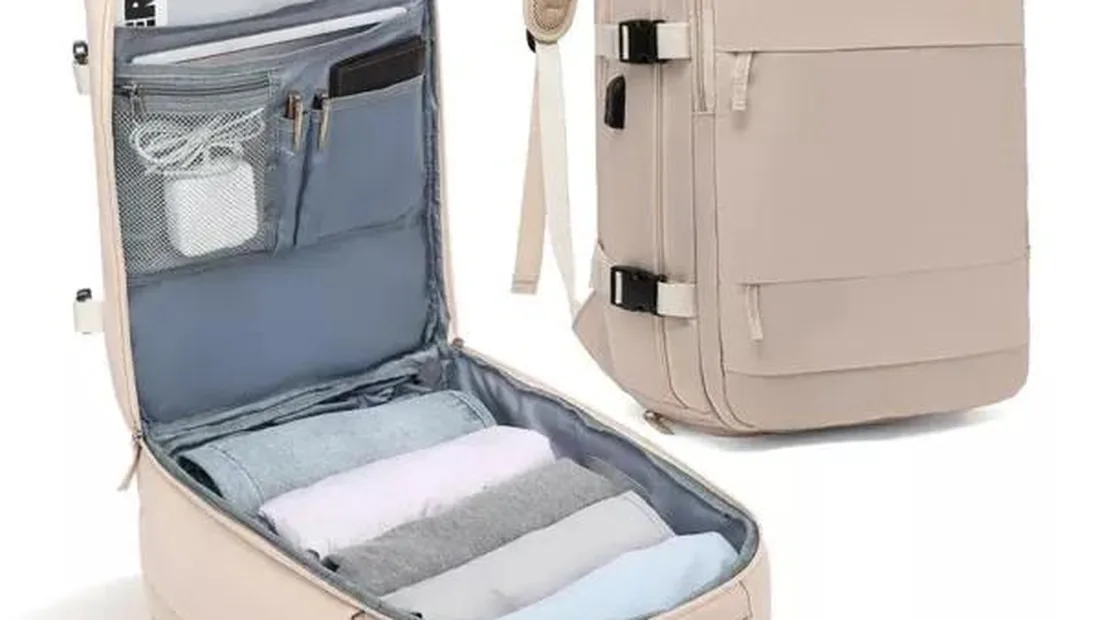
A bag quote is not one number. It is a stack of decisions you already made, whether you know it or not. When a buyer asks us why two backpacks with the same rough size land at different bag manufacturing cost, the answer is usually sitting in the bill of materials, the marker efficiency, or the tooling line. You don't need to be a cost engineer to read a quote properly. You need to know which costs are per unit and which costs happen once.
This guide walks through the layers. Face fabric, lining, interlining, foam, hardware, decoration, labor, packaging, and the amortised charges that hide at the bottom of a quotation. No fake percentages. The real numbers land in your quotation, because they depend on your spec.
Material cost is geometry first, fabric second
The single biggest driver in most bag manufacturing cost is the cut area of the pattern pieces. Not the finished bag size. A bag with a deep gusset, a curved top panel, or a wrap-around side pocket uses more square meters of fabric than a flat tote that looks the same size on a screen. That is where marker efficiency enters.
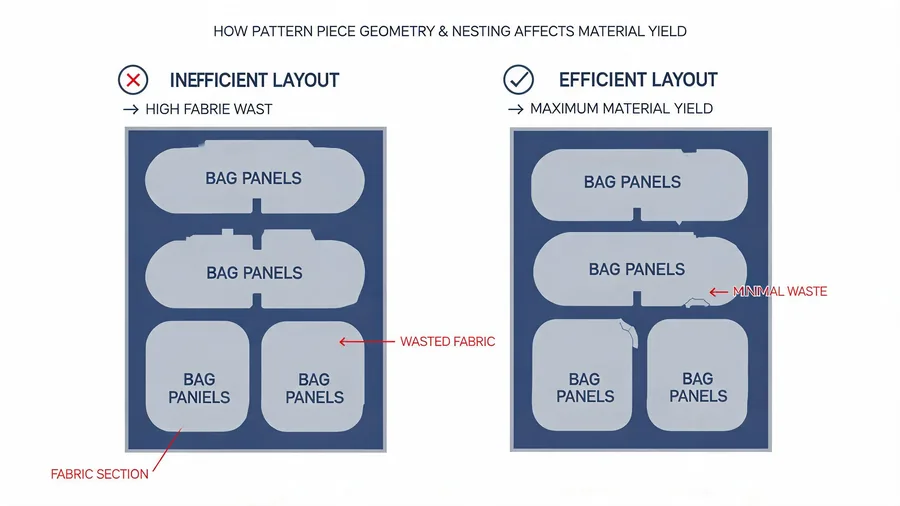
Marker efficiency is the percentage of fabric area that actually becomes pattern pieces. The rest is offcut between shapes. A rectangular panel with straight edges nests tightly. A curved panel, a tapered strap, or a circular bottom panel leaves gaps. Those gaps are paid fabric. When a designer adds a curved flap or a shaped side panel, the material cost rises even if the bag gets smaller.
Fabric specification matters next. Nylon, polyester, canvas, and cotton duck all price differently, and within each family you have denier, GSM, coating, and finish. A 600D polyester with a PU coating costs more than a 210T uncoated lining. Recycled content, water-repellent finish, and TPU lamination all move the number. The face fabric is the obvious cost. The lining and interlining are the quiet ones.
Interlining is the hidden layer between shell and lining. It gives structure, padding, or insulation. A backpack back panel might use closed-cell foam. A cooler bag uses expanded polyethylene foam in a specific thickness. A structured tote might use a fiberboard base. Every interlining layer adds material cost plus a cutting step plus a sewing step. Buyers sometimes forget the interlining when they compare two quotes line by line.
Hardware and decoration are line items, not afterthoughts
Zippers, buckles, sliders, D-rings, snaps, and hooks are not free. A bag with eight zipper pulls costs more in hardware than a bag with one. The finish matters too: matte black, antique brass, nickel, and custom-color coating all sit at different price points. A custom logo embossed on a metal plate is a tooling cost plus a per-unit cost.
Decoration splits into two buckets: per-unit and one-time. Screen printing, heat transfer, embroidery, and woven labels are per-unit charges. The setup behind them is not. A screen costs money once. An embroidery digitizing file costs money once. A metal logo plate needs a mold. A woven label needs a loom setup. These one-time charges get amortised across your order quantity.
That is why volume changes the unit cost even when nothing about the bag changes. A $300 screen setup on a 500-piece order adds $0.60 per bag. On a 5,000-piece order it adds $0.06. The bag is identical. The bag manufacturing cost is not.
Labor tracks construction complexity, not bag size
A simple drawstring bag with one seam and a cord channel takes minutes to sew. A backpack with a padded laptop sleeve, two side pockets, a front organizer panel, and a bound internal seam takes much longer. Labor cost follows the number of operations, the difficulty of each seam, and the care required around alignment marks and critical dimensions.
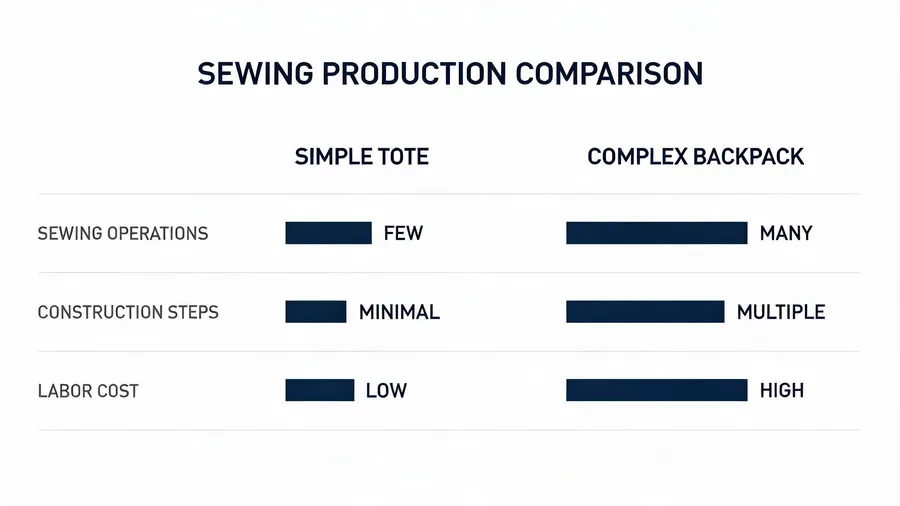
Think about a boxed bottom. A flat tote with a single bottom fold is one operation. A box construction with a separate bottom panel, four corner seams, and bound edges is several operations. Each operation is a station on the line, a worker's time, and a quality check. The same logic applies to darts, gussets, piping, edge painting, and bar tacks.
Materials also change labor. Sewing a stiff coated fabric is slower than sewing a soft uncoated one. Welded seams, radio-frequency welding, and ultrasonic welding require different equipment and different cycle times than lockstitch sewing. A waterproof roll-top with heat-sealed seams costs more in labor than a standard zipper closure, even if the fabric is the same.
Packaging has six decisions hiding in it
Packaging is the easiest place to overspend or underspend without noticing. A poly bag is the baseline. A color box adds structure, print, and assembly. A gift box with a handle bag adds two more layers. A branded poly mailer replaces the plain one. A hang tag plus poly bag adds a tag, a string, and a tagging operation. A dust bag is a separate fabric item with its own drawstring and sewing.
Each packaging option is a per-unit cost. The printing plates or cutting dies behind custom boxes are one-time costs. If you order 500 units with a custom color box, the box tooling amortises across those 500 units. If you reorder the same box later, the tooling is already paid. That is why reorders sometimes land at a lower unit cost than the first order, even with the same bag.
Volume tiers change the math, not just the price
Most factories quote in tiers. The MOQ is the floor. Above that, the unit cost drops as volume rises. The mechanism is not mysterious. Fabric is bought more efficiently in larger rolls. Cutting layouts waste less when more pieces share a marker. Setup time on a sewing line spreads across more units. Workers gain speed on a repeated style. Shipping a full container costs less per bag than shipping ten cartons by air.
But volume does not make every cost drop. Hardware is usually a straight per-unit cost. Decoration per-unit charges stay flat. Packaging per-unit charges stay flat. The savings concentrate in material yield, labor efficiency, and amortised tooling. That is why a quote for 5,000 units does not fall in half from the 500-unit quote. It falls in the places where scale actually helps.
One more thing about volume: color count. A buyer ordering 800 units in three colors pays for three cutting lays, three color changes on the line, and three sets of thread and zipper tape. A buyer ordering 800 units in one color pays once. The bag manufacturing cost per unit is lower for the single-color order, even though the total quantity is identical.
One-time costs you should expect to see
Patterns, samples, screens, molds, and color matching all appear as separate lines on a first order. Some buyers are surprised by this. They should not be. A pattern is developed once and used for every unit. A pre-production sample is made once. A lab dip for color approval is done once per color. These are not hidden fees. They are development work.
The table below separates the two cost types clearly.
| Cost item | Type | When it occurs | What it depends on |
|---|---|---|---|
| Face fabric, lining, interlining | Per unit | Every order | Cut area, material spec, marker efficiency |
| Foam and reinforcement | Per unit | Every order | Thickness, density, panel geometry |
| Zippers, buckles, hardware | Per unit | Every order | Count, finish, supplier |
| Screen printing, embroidery | Per unit | Every order | Decoration area, stitch count, colors |
| Pattern development | One-time | First order | Complexity, number of panels |
| Printing screens | One-time | First order per design | Number of colors, print size |
| Metal logo mold | One-time | First order per logo | Logo size, depth, finish |
| Woven label loom setup | One-time | First order per label | Label size, thread colors |
| Lab dip and color matching | One-time | First order per color | Fabric type, color standard |
| Packaging tooling | One-time | First order per box design | Box size, print coverage |
Read the quote line by line. Ask which lines disappear on reorder. Ask which lines are per unit and which are amortised. A good factory will tell you without hesitation. A vague quote that lumps everything into one number tells you less than you need.
How to compare two quotes correctly
Do not compare totals. Compare the stack. Two suppliers may quote the same bag at different totals because one included the pattern fee and one buried it in the unit price. One may quote a lower face fabric by using a lighter GSM or a cheaper coating. One may omit the interlining entirely. One may quote without packaging and add it later.
The only fair comparison is a line-by-line review against the same tech pack. Same materials, same construction, same decoration, same packaging, same volume tier. Then the difference is real. It reflects labor rates, overhead, marker efficiency, and margin. That is the number worth negotiating.
If you want to see how these layers apply to a specific category, our full product range shows the construction differences across backpacks, cooler bags, and woven bags. For a deeper look at construction-driven cost in one category, start with backpacks. If you are working through a first quote and want a factory-side read, send us the spec and we will walk through the layers with you.
Frequently asked questions
Why is my reorder cheaper than the first order?
Because the one-time costs are already paid. Patterns, screens, molds, lab dips, and packaging tooling do not repeat. The second order carries only per-unit material, labor, hardware, decoration, and packaging charges.
What is marker efficiency and why should I care?
Marker efficiency is how much of the fabric roll actually becomes pattern pieces. Curved panels and odd shapes waste more fabric than straight rectangles. That waste is paid fabric, so it raises material cost per bag.
Does a bigger bag always cost more to make?
No. A large flat tote with one seam can cost less in labor than a small structured backpack with a padded sleeve, bound seams, and six hardware pieces. Construction complexity drives labor. Geometry drives material.
How do I know if a quote is missing something?
Check for these lines: pattern fee, sample fee, screen or mold charges, packaging, and freight. If they are absent, ask whether they are included in the unit price or billed separately. A complete quote shows both per-unit and one-time lines.
Frequently Asked Questions
Why is my reorder cheaper than the first order?
Because the one-time costs are already paid. Patterns, screens, molds, lab dips, and packaging tooling do not repeat. The second order carries only per-unit material, labor, hardware, decoration, and packaging charges.
What is marker efficiency and why should I care?
Marker efficiency is how much of the fabric roll actually becomes pattern pieces. Curved panels and odd shapes waste more fabric than straight rectangles. That waste is paid fabric, so it raises material cost per bag.
Does a bigger bag always cost more to make?
No. A large flat tote with one seam can cost less in labor than a small structured backpack with a padded sleeve, bound seams, and six hardware pieces. Construction complexity drives labor. Geometry drives material.
How do I know if a quote is missing something?
Check for these lines: pattern fee, sample fee, screen or mold charges, packaging, and freight. If they are absent, ask whether they are included in the unit price or billed separately. A complete quote shows both per-unit and one-time lines.