Bag printing methods matter more than most buyers expect. The decoration sits on the outside of the product, gets touched every day, and fails in public. A cracked logo on a backpack tells a different story than a clean woven label on a cooler bag. This guide compares the main decoration methods used in custom bag production and explains where each one fits.
You'll see the same methods come up again and again: screen printing, digital textile printing, dye sublimation, heat transfer, embroidery, labels, debossing, embossing, laser engraving and foil. Each one has a substrate it loves and a substrate it ruins. Each one has an artwork limit and a durability profile. Pick wrong and you'll pay for it twice, once at production and again when the buyer returns the bag.
Before we go method by method, a word on how we use the term bag printing methods. It covers any process that puts a design, logo or text onto a bag surface. Some methods print, some stitch, some press, some burn. The right one depends on the material, the artwork, the order size and where the bag will be used.
Screen printing
Screen printing forces ink through a prepared screen onto the material. It suits solid colors and repeat production when the substrate and ink system are compatible. The process works well on flat panels, canvas, polyester and nylon. It's less happy on textured surfaces, stretchy panels or areas with zippers nearby.
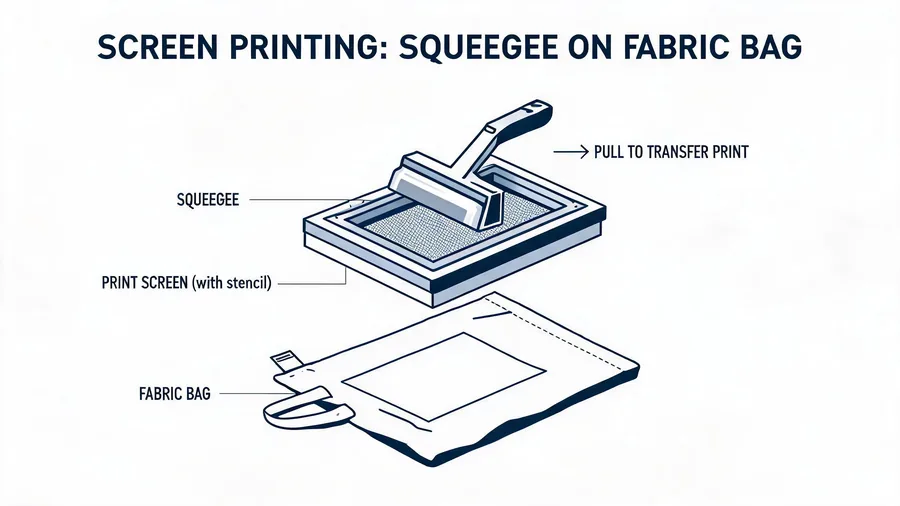
Artwork limits are real. Fine gradients, photographic detail and very small text tend to close up or break. Screen printing rewards bold shapes and solid fills. It's cheap at volume. Setup costs get spread across the run, so a buyer ordering 800 units in three colors can get a strong price per unit.
Durability depends on the ink system and the cure. A properly cured plastisol or water-based ink can survive years of use on a backpack. A poorly cured print flakes off in weeks. Ask your supplier how they test adhesion and wash fastness. If they can't answer, keep looking. Screen printing fails when the ink doesn't bond to the coating, when the print crosses a seam, or when the bag flexes constantly at the print area.
Digital textile printing
Digital textile printing lays down ink with controlled inkjet deposition. It supports detailed graphics and shorter runs. The ink chemistry is selected for the fiber type. This is the method for photographic artwork, gradients, fine lines and variable data.
It works best on smooth, light-colored fabrics. Dark fabrics need a white underbase, which adds cost and changes hand feel. Coated fabrics can reject the ink. Nylon is trickier than polyester. Canvas takes digital printing well if the surface is smooth enough.
Durability is generally good when the ink is fixed correctly. The print sits on the surface, so heavy abrasion can wear it down over time. For a cooler bag that gets wiped down constantly, a digital print may not be the first choice. For a promotional tote or a fashion backpack panel, it can be perfect.
Where digital textile printing fails: on stretchy mesh, on heavily textured woven bags, and on any surface where the print head can't maintain a consistent distance. It also struggles with metallic or neon spot colors that screen printing handles easily.
Dye sublimation
Dye sublimation is a transfer process. Disperse dye becomes a gas under heat and pressure and bonds with suitable polyester surfaces. The key word is polyester. Sublimation needs polyester or a polyester-coated substrate. It will not hold on cotton canvas or nylon.
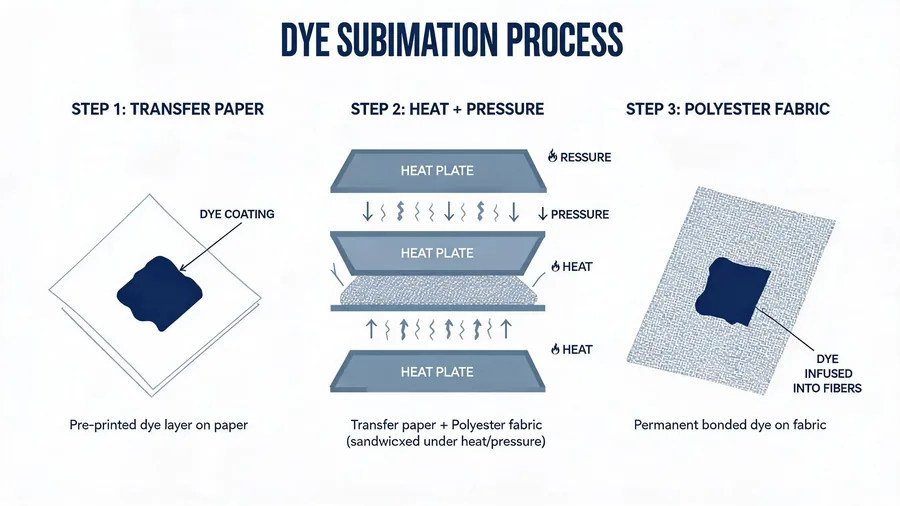
That's the first thing to check. A buyer who wants a sublimated logo on a 100% cotton tote is asking for a print that washes out. The same buyer can get a brilliant result on a polyester drawstring bag or a polyester-faced cooler bag. The dye goes into the fiber, not onto it. The print becomes part of the material.
That's why sublimation durability is so good. There's no surface layer to crack or peel. The print can stretch, flex and wash without failing. It works for all-over prints, edge-to-edge coverage and photographic detail. Artwork limits are minimal. If you can print it on paper, you can sublimate it.
Sublimation fails on dark fabrics, because there's no white ink in the process. It fails on non-polyester materials. It also fails when the transfer is pressed at the wrong temperature or pressure, leaving a ghosted or faded image. Ask your supplier to validate the transfer on your exact fabric before production.
Heat transfer graphics
A heat-transfer graphic is a prepared graphic transferred to the material with heat and pressure. It covers a lot of ground: plastisol transfers, vinyl cuts, printed films, reflective transfers. The common thread is a carrier sheet, heat and pressure.
Heat transfer suits small logos, names, numbers and multi-color designs on hard-to-print surfaces. It works on nylon, polyester, coated fabrics and some canvas. It's a good fallback when screen printing can't reach the spot or digital printing can't bond to the coating.
Durability varies widely. A good heat transfer with the right adhesive and pressure can last the life of the bag. A cheap one peels at the edges. Adhesion, stretch, wash and abrasion performance must be validated on the actual material. The failure mode is almost always at the edge, where the transfer meets the fabric.
Heat transfer fails on high-stretch panels, on surfaces with heavy texture, and on bags that get crushed in transit. It also fails when the transfer is applied over a seam or a zipper. The pressure can't be even.
Embroidery and patch embroidery
Embroidery stitches thread into the material to create a durable raised design. It's the classic choice for backpacks, caps and premium bags. The look is dimensional. The feel is substantial. The durability is excellent when the construction is right.
Embroidery needs backing. The backing stabilizes the fabric during stitching and prevents distortion. Without it, the design puckers, shifts and looks amateur. Stitch density control matters too. Too many stitches in a small area can perforate the fabric. Too few can leave gaps. The digitizer sets the stitch path, the density and the underlay. A bad digitizer ruins a good logo.
Artwork limits are real. Fine text under about 6 mm tends to blur. Gradients don't exist in thread. Photographic detail is out. Embroidery rewards bold shapes, clear lettering and simple color blocks. It also adds weight and stiffness to the panel, which can affect how a backpack feels.
Patch embroidery is a separate route. The design is embroidered onto a separate patch, then the patch is sewn or heat-sealed onto the bag. This lets you produce patches in bulk and apply them to different bag styles. It also lets you use a woven edge, a merrowed edge or a laser-cut shape.
Embroidery fails on thin fabrics, on coated fabrics that can't take needle penetration, and on panels with heavy padding underneath. It also fails when the backing is too light or the stitch density is too high for the fabric. Ask to see a sew-out on your actual material before you commit.
Labels: woven, printed and thermal transfer
Labels carry the brand, care instructions, composition, origin and size. They're not decoration in the same way a big chest print is, but they matter just as much. A cheap label on a premium bag undercuts the whole product.
A woven label creates the design by interlacing yarns. It's the most durable label type. It survives washing, abrasion and years of use. The detail level is limited by the weave. Very fine text or complex logos can lose clarity.
A printed label carries ink-printed care, composition, origin, size or identification information. It's cheaper than woven and faster to produce. It can show fine detail and multiple colors. Durability is lower. The print can fade or wear off with repeated washing.
A thermal-transfer label is a durable variable-data label printed by transferring wax, wax-resin or resin from a ribbon to a compatible substrate. It's used for barcodes, serial numbers, batch codes and other variable data. Resin ribbons give the best durability. Wax ribbons are cheaper but wear faster.
Labels fail when the attachment method is wrong. A sewn-in label can tear at the seam. A heat-sealed label can peel. A printed label can fade. Match the label to the bag's life. A cooler bag that gets wiped down daily needs a different label than a fashion tote that sits in a closet.
Debossing, embossing, laser engraving and foil
These four methods share a common thread: they add dimension or shine without adding a separate material layer. They work on leather, synthetic leather, rubber, some coated fabrics and rigid components.
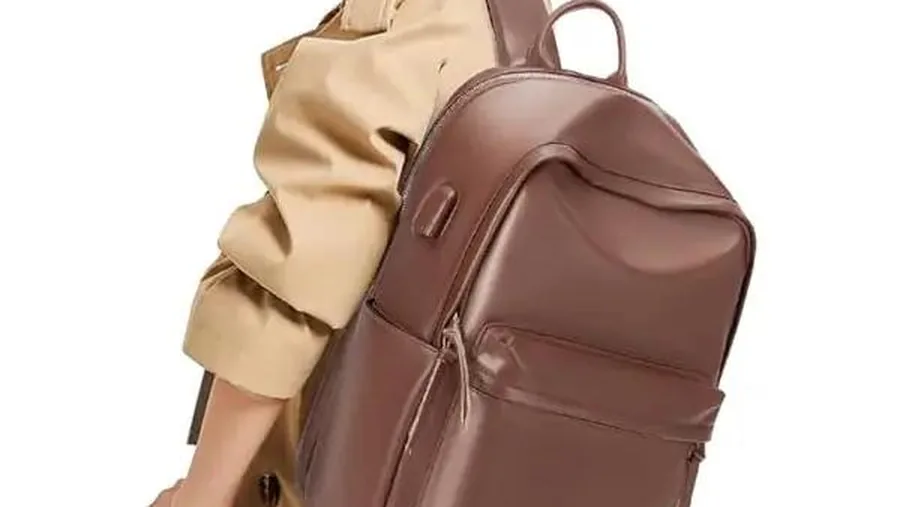
Debossing forms a recessed mark by pressure, sometimes with heat. It's subtle and premium. It works best on leather and synthetic leather. The mark is permanent in the sense that it can't peel, but it can flatten over time if the material is soft.
Embossing forms a raised or textured mark by pressure, heat or a patterned surface. It's the opposite of debossing. It adds a tactile element. It works on the same materials. Both methods need a die, so setup cost is real. They make sense when the logo is simple and the material can hold the impression.
Laser engraving burns the surface to create a mark. It works on leather, synthetic leather, some coated fabrics and rigid parts like buckles or zipper pulls. The detail can be very fine. The mark is permanent. But laser engraving changes the surface chemistry. On some materials it can weaken the area or create a burnt edge. Test it.
Foil applies a metallic or colored film to the surface with heat and pressure. It's often combined with debossing or embossing. The foil sits on top of the material, so it can wear off under abrasion. It's a premium look for gift boxes, hang tags and small logo areas. It fails on stretchy or heavily textured surfaces.
All four methods fail when the material is too soft, too stretchy or too textured to hold the impression or the foil. They also fail when the logo has fine detail that closes up under pressure. Ask your supplier for a strike-off on your exact material. One sample beats a hundred promises.
Decision table
This table maps common artwork types and substrates to the method that usually makes sense. It's a starting point, not a rule. Your exact material, order size and durability requirement can shift the answer.
| Artwork type | Common substrate | Sensible method | Watch out for |
|---|---|---|---|
| Solid logo, 1-3 colors | Canvas, polyester, nylon | Screen printing | Ink adhesion on coated fabrics |
| Photographic or gradient | Polyester | Dye sublimation | Does not work on cotton or nylon |
| Photographic or gradient | Cotton canvas, light fabric | Digital textile printing | White underbase on dark fabric |
| Small multi-color logo | Nylon, coated fabric | Heat transfer | Edge peeling on stretch panels |
| Bold emblem or monogram | Backpack panel, cap | Embroidery | Backing and stitch density |
| Brand name, care info | Any fabric | Woven or printed label | Attachment method |
| Simple logo on leather | Leather, synthetic leather | Debossing or embossing | Die cost, material memory |
| Fine detail on rigid part | Buckle, zipper pull | Laser engraving | Surface weakening |
Minimum order quantities for logo methods vary by supplier. Some methods need a few hundred units to make sense. Others work at very small runs. Ask your supplier for their minimums before you design around a method. A buyer who designs a foil logo and then finds out the minimum is too high has wasted a week.
How to choose without guessing
You don't need to become a decoration engineer. You need to ask three questions. First, what material is the bag? Second, what does the artwork look like? Third, where will the bag be used?
Say a buyer wants a photographic logo on a polyester backpack. Sublimation is the obvious answer. The same logo on a cotton canvas tote pushes toward digital textile printing. The same logo on a nylon cooler bag pushes toward heat transfer. Same artwork, three different methods. The substrate decides.
Then think about failure. Imagine a cooler bag with a heat-transferred logo on the front pocket. The pocket flexes every time someone reaches inside. Six months later the edges lift. That's not a surprise. It's a predictable failure that a different method or a different placement would have avoided.
Durability is not a spec sheet number. It's a behavior. A sublimated print becomes part of the fiber. An embroidered logo sits proud of the surface. A screen print lies on top. Each one fails differently. Ask your supplier to name the failure mode for the method they recommend. If they hesitate, ask someone else.
We've covered the main methods, their limits and where they fail. The decision table gives you a starting point. The questions give you a filter. The rest is testing on your actual material. No guide can replace a strike-off on the exact fabric you'll ship.
For more on how we build custom bags, see our product range, our backpack manufacturing and our woven bag options. If you have a specific artwork or substrate in mind, contact us and we'll recommend a method that fits.
Frequently Asked Questions
Which bag printing method lasts the longest?
Dye sublimation on polyester and properly constructed embroidery tend to last the longest. Sublimation bonds dye into the fiber, so there's no surface layer to crack. Embroidery is a separate thread structure that survives abrasion well when the backing and stitch density are correct. The longest-lasting method for your bag depends on the material and where the decoration sits.
Can I print a photo on a cotton canvas bag?
Yes, digital textile printing handles photographic detail on cotton canvas. It works best on smooth, light-colored fabric. Dark canvas needs a white underbase, which adds cost and changes the feel. Dye sublimation will not work on cotton, so digital printing is the usual route for photographic artwork on cotton bags.
Why does sublimation only work on polyester?
Sublimation uses disperse dye that turns into a gas under heat and bonds with polyester fibers. The dye enters the fiber rather than sitting on top of it. Cotton, nylon and other fibers don't accept the dye the same way. A polyester-coated surface can work, but the coating must be designed for sublimation.
What is the minimum order for embroidered logos on bags?
Minimums vary by supplier and by the complexity of the logo. Some methods need a few hundred units to make sense, while others work at very small runs. Ask your supplier for their logo-method minimums before you design around a particular decoration. A simple woven label often has a different minimum than a full embroidery setup.