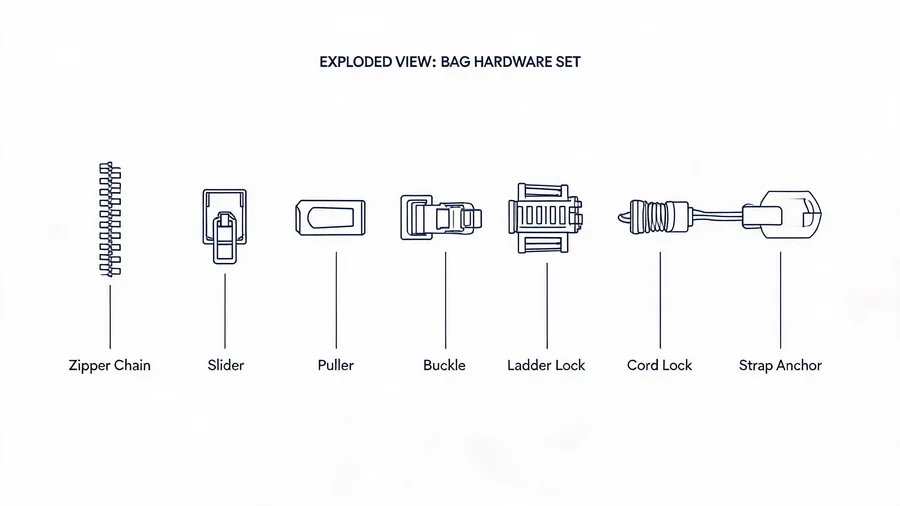
Bag hardware is the set of components that let a bag open, close, adjust, attach, and survive daily abuse. A buyer specifying custom backpacks, cooler bags, or woven bags will spend more time on hardware than on any other trim category. Get it wrong and the bag fails at the zipper or the strap anchor. Get it right and the bag feels expensive even when it isn't.
This guide walks through the full hardware set from the industry reference, what each part does, how to specify it, when metal beats resin, and the attachment methods that decide whether hardware stays attached. It closes with the tests that matter.
The Hardware Set, Part by Part
You don't specify hardware in isolation. You specify a system. A zipper needs a slider and a puller. A strap needs a buckle or a ladder lock. A drawcord needs a cord lock. If one part is under-specified, the whole system underperforms.
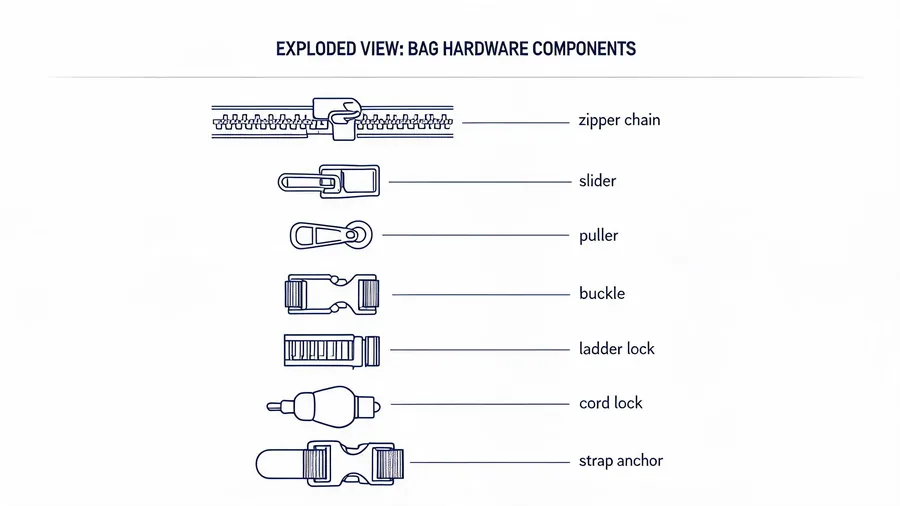
The zipper chain is the interlocking teeth or coils attached to textile tapes. It's the part buyers see first and the part that fails most often when corners are cut. The slider is the moving component that joins or separates the chain. The puller is the tab attached to the slider for hand operation. These three parts are specified together: chain size, slider type, and puller material.
Buckles are quick-release or adjustment components used with webbing. A ladder lock is a webbing adjuster that changes strap length and holds the selected position under tension. A tri-glide is a three-slot webbing adjuster used for length adjustment or strap retention. A cord lock is a spring or friction device that holds a drawcord at an adjusted position. These four parts handle almost all strap and cord adjustment on bags.
Hook-and-loop fastener is a two-part textile closure used for flaps, dividers, patches, and removable components. It's not metal hardware, but it's specified in the same BOM section and it behaves differently under load and repeated cycling. Webbing is a narrow woven tape used for straps, handles, reinforcement, binding, and attachment points. Elastic binding is a stretch edge finish used around pockets and openings. Piping is a corded or flat edge detail inserted into a seam for shape, protection, or appearance.
D-rings are D-shaped rings used as attachment or routing points. Swivel hooks are rotating hooks used on detachable straps and accessories. Rivets are mechanical fasteners used where the material stack and load direction are suitable. Grommets are reinforced rings fitted into a hole for drainage, ventilation, or cord routing. Each part has a job. Specify the job, not just the part name.
How to Specify Each Component
A BOM line that says "zipper" is useless. A BOM line that says "#5 nylon coil zipper, reversed, with metal puller and rubberized pull tab, YKK or equivalent, black tape, nickel slider" is a specification. The difference is the number of decisions you've made before the factory quotes.
For zippers, specify chain type, chain size, tape color, slider finish, puller style, and whether the zipper is reversed or standard. Reversed zippers hide the chain behind the tape and look cleaner on the outside of a bag. They also cost slightly more and require different sewing.
For buckles and adjusters, specify the webbing width they must accept, the material, the finish, and the load direction. A side-release buckle on a backpack sternum strap is not the same as a side-release buckle on a cooler bag shoulder strap. One is cosmetic. The other carries load.
For D-rings and swivel hooks, specify the inner diameter, the material thickness, the finish, and the attachment method. A D-ring sewn into a seam with a bar tack behaves differently from one riveted through a reinforced panel. Both are valid. Neither is universal.
For grommets, specify the inner diameter, the material, and whether the grommet is set with a washer. Drainage grommets on a cooler bag need to resist corrosion. Ventilation grommets on a backpack need to hold their shape under tension. The same part name covers both jobs.
Metal vs. Resin: When Each Wins
Metal hardware feels premium. It's heavier, it's colder to the touch, and it makes a sound when it clicks. Buyers specifying fashion backpacks or premium cooler bags often default to metal because it signals quality. But metal isn't always the right call.
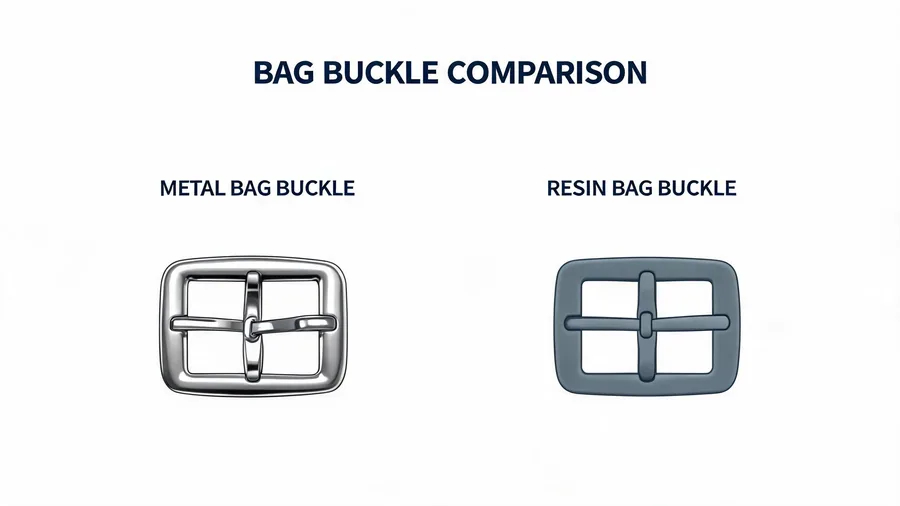
Resin, acetal, and nylon hardware are lighter, cheaper, and quieter. They don't corrode. They don't scratch phone screens or laptop lids when a strap swings. They're the standard choice for athletic bags, kids' backpacks, and any product where weight matters more than perceived luxury.
Metal wins when the hardware is visible and the brand story is about durability or heritage. A brass zipper on a waxed canvas backpack reads as intentional. The same brass zipper on a gym duffel reads as over-specified and heavy.
Resin wins when the hardware is functional and hidden. A cord lock inside a drawstring bag doesn't need to be metal. A ladder lock on a webbing strap doesn't need to be metal. The load is the same. The cost and weight are not.
One practical note: if you're specifying metal hardware for a bag that will ship by sea, specify a finish that survives salt air. Uncoated steel will rust in transit. Nickel plating helps. Powder coating helps more. The finish is part of the specification, not an afterthought.
Finishes and Corrosion Behaviour
Metal hardware finishes fall into a few broad families. Nickel plating is common and inexpensive. It resists corrosion reasonably well but can wear through at high-friction points. Chrome plating is brighter and harder but more expensive. Antique brass and antique nickel are plated finishes with a darkened recess that hides wear.
Powder coating is a dry finish applied electrostatically and cured under heat. It's thicker than plating and resists scratching better. It's common on carabiners, large D-rings, and hardware that takes impact. The trade-off is that powder coating can chip if the underlying metal flexes.
Stainless steel is the most corrosion-resistant common hardware material. It costs more and it's heavier than zinc alloy. It's the right call for marine bags, cooler bags that sit in melted ice, and any product marketed for wet conditions.
Zinc alloy is the workhorse. It's cheap, it casts well, and it takes plating beautifully. It's the base material under most plated buckles, sliders, and D-rings. The plating is what protects it. Specify the plating thickness if you can, and specify a salt spray test if the bag will see coastal or marine use.
Attachment Methods That Decide Durability
Hardware fails in two ways. The hardware itself breaks, or the attachment fails. In our experience, the attachment fails more often. A buckle that's still intact on a strap that tore out of the seam is a failed bag.
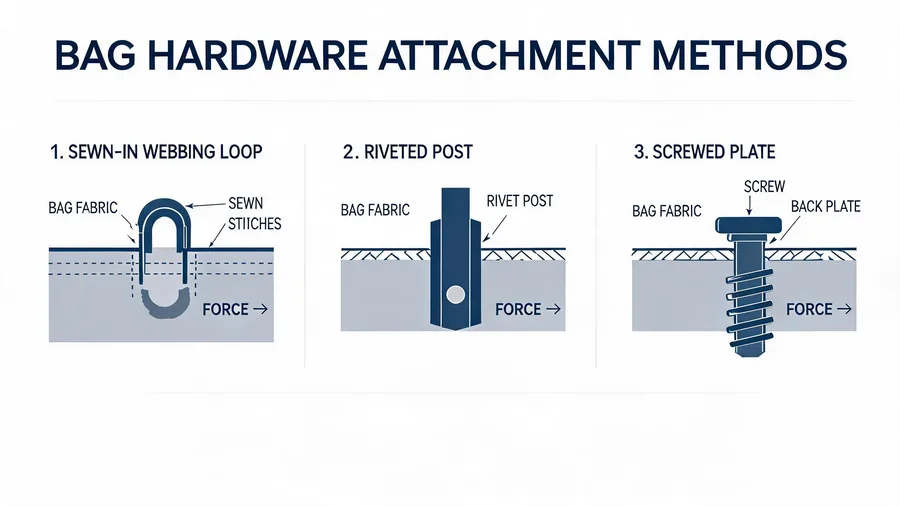
Bar tacks are dense short stitch patterns used to reinforce high-stress points. They're the standard attachment for webbing loops, strap ends, and D-ring tabs. A bar tack spreads load across the stitch pattern rather than concentrating it at a single point.
Box-X stitches are rectangular reinforcement stitches with diagonal crossing lines. They're used at webbing attachments where the load pulls in multiple directions. A backpack strap anchor sewn with a box-X will outlast the same anchor sewn with a straight stitch. The difference is not subtle.
Rivets are mechanical fasteners used where the material stack and load direction are suitable. A rivet through a leather strap end and a bag panel holds because the rivet body deforms and locks the layers together. Rivets are fast to set and they don't unravel. But they concentrate load in a small area, so the material around the rivet needs reinforcement.
Reinforcement patches are the unsung hero of hardware attachment. A piece of nylon or polyester webbing folded behind a D-ring tab spreads the load across a larger seam area. Without the patch, the D-ring pulls through the shell fabric. With it, the bag survives years of use.
The rule is simple: any hardware that carries load needs a reinforcement patch or a bar tack or a box-X. Cosmetic hardware can get away with a straight stitch. Load-bearing hardware cannot.
Hardware BOM Fields
When you send a hardware specification to a factory, use a table. It forces you to make decisions and it gives the factory something to quote against. Here's the structure we use for custom backpacks and it works for any bag type.
| Component | BOM Fields | Example Entry |
|---|---|---|
| Zipper chain | Type, size, tape color, supplier | #5 nylon coil, black tape, YKK or equivalent |
| Slider | Material, finish, locking or non-locking | Zinc alloy, nickel, non-locking |
| Puller | Material, length, finish | Metal, 25 mm, antique brass |
| Buckle | Type, webbing width, material, finish | Side-release, 25 mm, acetal, black |
| Ladder lock | Webbing width, material, finish | 25 mm, acetal, black |
| Tri-glide | Webbing width, material, finish | 20 mm, nylon, black |
| Cord lock | Cord diameter, material, finish | 4 mm, acetal, black |
| Hook-and-loop | Width, color, hook density | 25 mm, black, standard density |
| D-ring | Inner diameter, material, finish | 25 mm, zinc alloy, nickel |
| Swivel hook | Inner diameter, material, finish, load rating | 20 mm, zinc alloy, gunmetal |
| Rivet | Diameter, material, finish, washer | 8 mm, brass, antique, with washer |
| Grommet | Inner diameter, material, finish | 10 mm, brass, nickel |
This table is a starting point. For cooler bags, add a corrosion note to every metal component. For woven bags, specify whether hardware is sewn through the woven panel or attached to a separate webbing tab. The BOM fields don't change. The values do.
Hardware-Related Tests
The industry reference names the tests that matter for hardware. They're not exotic. They're the tests a competent factory runs before shipping and the tests a buyer should request when the bag will see hard use.
Zipper cycling tests open and close the zipper repeatedly under controlled conditions. The test catches slider wear, chain misalignment, and puller failure. The number of cycles depends on the agreed specification. A bag marketed for daily use should survive more cycles than a promotional tote.
Pull tests apply force to the hardware attachment point until something fails. The test measures whether the bar tack, box-X, or rivet holds under load. The force value is set in the approved specification. What matters is that the attachment fails after the hardware, not before it.
Salt spray tests expose plated metal hardware to a corrosive mist for a defined period. The test predicts how the finish will behave in coastal or marine conditions. If you're specifying metal hardware for a bag that ships by sea, ask for a salt spray report on the plated parts.
Stitches per inch is a stitch-density measure that affects seam appearance, flexibility, and performance. It's not a hardware test, but it's the measure that determines whether the bar tack and box-X stitches do their job. Too few stitches per inch and the attachment fails. Too many and the material perforates.
These tests are standard industry practice. The exact values, cycle counts, and load thresholds are set in the approved specification for each bag. Don't accept a quote that doesn't reference them.
Hardware is the part of the bag that buyers touch first and remember longest. Specify it like you mean it. Your factory will quote it correctly, and your customers will feel the difference. For a full walkthrough of our OEM process, see how we work or send us your hardware list.
Frequently Asked Questions
What's the difference between a bar tack and a box-X stitch?
A bar tack is a dense short stitch pattern that reinforces a single high-stress point. A box-X is a rectangular stitch with diagonal crossing lines that spreads load in multiple directions. Use a bar tack for strap ends and a box-X for webbing attachments that pull at an angle.
Should I use metal or resin hardware on my backpack?
Metal reads as premium and is heavier. Resin is lighter, cheaper, and quieter. If the hardware is visible and the brand story is durability or heritage, metal works. If the bag is athletic or weight-sensitive, resin is the better call.
How do I prevent metal hardware from rusting during sea freight?
Specify a corrosion-resistant finish. Nickel plating is the minimum. Powder coating and stainless steel hold up better in salt air. Ask for a salt spray test report on plated parts if the bag will ship by sea or sell in coastal markets.
What hardware tests should I ask for before production?
Zipper cycling tests, pull tests on attachment points, and salt spray tests on plated metal. The exact values depend on your approved specification. A competent factory will reference these tests in the quote without being prompted.